
How to Choose the Right Camera for Your Photography Style
Finding the perfect camera can feel like navigating a maze blindfolded. With tech specs evolving rapidly, marketing hype shouting from every corner, and thousands of dollars on the line, it is incredibly easy to experience choice paralysis.
But here is the truth: there is no single “best camera in the world.” There is only the best camera for you.
A wildlife photographer freezing a cheetah in motion needs vastly different gear than a studio portraitist capturing fine skin textures or a travel blogger shooting handheld vlogs in crowded night markets. Buying a camera based solely on a high megapixel count or influencer hype often leads to a heavy, complicated device that sits in your closet gathering dust.
This comprehensive guide will help you strip away the technical jargon, align your gear choices with your creative vision, and find a camera that feels like an extension of your hand.
1. Understanding Your Photography Style
Before diving into sensor sizes or brands, you need to look at your creative intentions. Your photography style dictates the features you must prioritize—and the ones you can safely ignore.
Street and Documentary Photography
If you love capturing candid moments, urban life, and raw human emotions, your primary needs are discretion, portability, and speed. You want a camera that does not scream “professional photographer” to passersby. A fast autofocus system and a quiet shutter are essential here.
Landscape and Travel Photography
For sweeping mountain ranges, starry nights, or historic architecture, your focus shifts to dynamic range, weather sealing, and battery life. Travel photographers also need to balance capability with weight, as hiking for miles with a massive setup is a recipe for physical exhaustion.
Portrait and Studio Photography
If your goal is to capture stunning human subjects, fine details, and creamy, blurred backgrounds (bokeh), you need to look at sensor size and lens ecosystems. Portraiture thrives on superior low-light performance and the ability to separate the subject from the background.
Action, Sports, and Wildlife Photography
Capturing unpredictable subjects from a distance requires raw power. You need a camera body capable of high burst rates (frames per second), advanced subject-tracking autofocus, and compatibility with heavy telephoto lenses.
2. Sensor Sizes Demystified: Full-Frame vs. APS-C vs. Micro Four Thirds
The sensor is the heart of your camera. It captures the light that forms your image, and its physical size impacts everything from image quality to the physical bulk of your gear bag.
| Sensor Type | Best For | Key Advantage | Major Trade-off |
| Full-Frame | Portraits, Landscapes, Low-light | Exceptional dynamic range & depth control | Expensive, larger bodies and lenses |
| APS-C (Crop) | All-rounders, Street, Action | Excellent balance of price, size, and power | Slight loss in low-light performance |
| Micro Four Thirds | Wildlife, Travel, Vlogging | Ultra-compact systems, massive lens reach | Reduced performance in extreme low light |
The Full-Frame Advantage
A full-frame sensor matches the size of traditional 35mm film. Because the pixels are physically larger, they gather more light, offering cleaner images at high ISO settings and a shallower depth of field. If you shoot professionally indoors or crave maximum detail for large landscape prints, this is your gold standard.
The Pragmatic Appeal of Crop Sensors (APS-C & M4/3)
Smaller sensors mean smaller cameras and lenses. An APS-C or Micro Four Thirds system allows you to pack a professional-grade kit into a small backpack. Furthermore, the “crop factor” artificially extends the reach of your lenses, making a 300mm lens behave like a 450mm or 600mm lens—a massive bonus for budget-conscious wildlife and sports enthusiasts.
3. Mirrorless vs. DSLR: The Battle is Over
For over a decade, beginners faced a brutal choice: DSLR or Mirrorless? Today, the industry has spoken. Mirrorless technology is the present and the future.
Why Mirrorless Has Won
DSLRs use a mechanical mirror system to reflect light into an optical viewfinder. Mirrorless cameras remove this mechanism entirely, allowing light to hit the sensor directly. This architectural shift provides game-changing advantages:
-
What You See Is What You Get: Electronic viewfinders (EVFs) show you exactly how your final exposure, contrast, and color will look before you press the shutter.
-
Intelligent Autofocus: Modern mirrorless systems use AI to track human eyes, animal eyes, vehicles, and birds with pinpoint accuracy across the entire frame.
-
Video Integration: Because they are built from the ground up for live digital feeds, mirrorless cameras offer vastly superior video features compared to legacy DSLRs.
While you can find incredible deals on used DSLRs today, investing in a modern mirrorless system ensures access to cutting-edge lens development and long-term ecosystem support.
4. Key Specifications That Actually Matter (And What to Ignore)
Camera marketing is filled with astronomical numbers designed to trigger FOMO (Fear Of Missing Out). Let us separate the vital metrics from the vanity specs.
Megapixels: The Great Myth
Unless you are printing massive commercial billboards or cropping aggressively into your photos, you do not need 50 or 60 megapixels. For web display, social media, and standard prints, 24 megapixels is the sweet spot. It provides stunning clarity without bloating your hard drive with massive file sizes.
In-Body Image Stabilization (IBIS)
IBIS shifts the camera sensor physically to compensate for shaky hands. This feature is a lifesaver for travel and street photographers, allowing you to shoot crisp handheld photos at slow shutter speeds in low light without relying on a bulky tripod.
Autofocus Points and Subject Tracking
Look closely at the autofocus capabilities. A high number of phase-detection points coupled with real-time tracking will save you more missed shots than any increase in megapixel count ever could.
5. The Lens Dilemma: Why the Body is Just Half the Story
A common beginner mistake is spending 95% of the budget on an expensive camera body and using a cheap, low-quality “kit lens.”
Pro Tip: The camera body is the brain, but the lens is the eye. Your image quality is ultimately capped by the glass you put in front of your sensor.
Budgeting for an Ecosystem
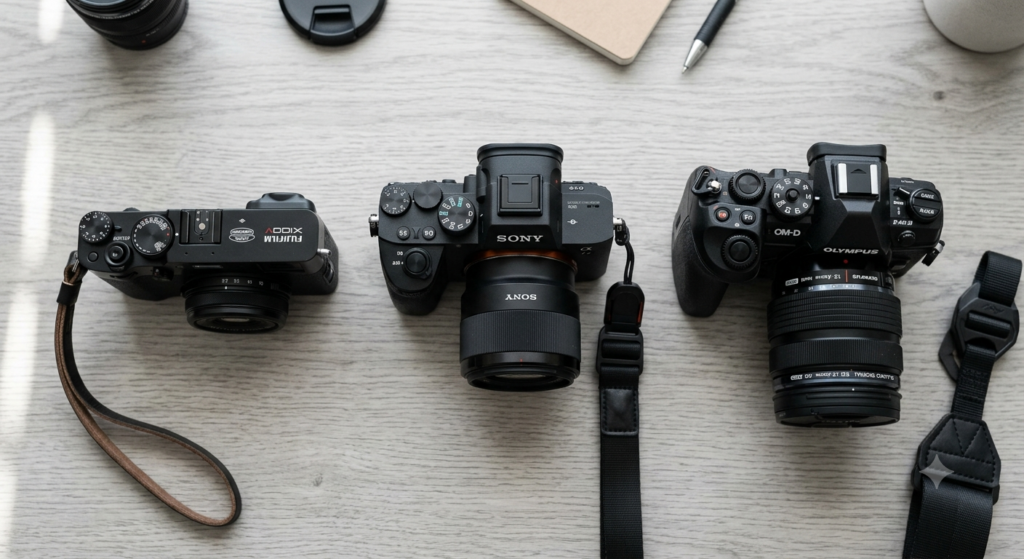
When choosing a camera system, look closely at the lens catalog of that brand (Sony, Canon, Nikon, Fujifilm, etc.). Ensure there are affordable, high-quality prime and zoom lenses available for your specific style.
If you shoot portraits, you will want a fast prime lens (like a 50mm f/1.8). If you shoot landscapes, a wide-angle zoom is your priority. Always leave a healthy portion of your budget dedicated to quality glass.
6. How to Choose Based on Your Real-World Budget
Let’s look at practical allocations to maximize the value of your hard-earned money.
The Entry-Level Budget ($600 – $1,000)
-
What you get: Excellent APS-C or Micro Four Thirds mirrorless bodies bundled with a versatile zoom lens.
-
Who it’s for: Hobbyists, family archivists, and travelers who want a massive upgrade over smartphone imagery without breaking the bank.
For Enthusiast / Mid-Range Budget ($1,500 – $2,500)
-
What you get: Advanced crop-sensor cameras or entry-level full-frame bodies featuring IBIS, weather resistance, and robust video capabilities.
-
Who it’s for: Serious hobbyists, side-hustlers, and hybrid creators who shoot both high-quality video and stills.
The Professional Tier ($3,000+)
-
What you get: High-megapixel or high-speed full-frame flagships built like tanks, featuring dual card slots, massive batteries, and uncompromised low-light performance.
-
Who it’s for: Working professionals whose income depends on capturing the shot perfectly every single time.
Conclusion: Making Your Final Decision
At the end of the day, specs on a sheet cannot capture the most critical element of a camera: ergonomics and user experience.
If possible, visit a local camera store and hold the models you are considering. Does the menu system feel intuitive? Do your fingers naturally rest on the control dials? Is it too heavy for you to carry around comfortably for four hours?
The right camera is the one that inspires you to pick it up, head out the door, and create art. Identify your style, pick your sensor size, prioritize the lenses, and start shooting.
Frequently Asked Questions (FAQ)
Should I buy a camera if my smartphone has 100 megapixels?
Yes, if you want creative control. While smartphone computation is amazing, small phone sensors cannot replicate the natural optical depth, low-light performance, and dynamic range of a dedicated camera sensor. Furthermore, a physical camera offers manual controls and interchangeable lenses that completely change how you compose a shot.
Is it safe to buy used camera gear?
Absolutely. Buying used gear from reputable retailers (who offer warranties and thoroughly inspect shutter counts) is one of the smartest ways to stretch your budget. You can easily save 30% to 40% on excellent condition bodies and lenses.
How much should I spend on a camera body versus a lens?
A solid rule of thumb for beginners and enthusiasts is to allocate roughly 50% to 60% of your budget to the camera body and the remaining 40% to 50% to a high-quality lens or two.
Does brand matter when choosing a camera?
Not as much as it used to. Sony, Canon, Nikon, and Fujifilm all make exceptional cameras. Instead of focusing on brand loyalty, focus on ergonomics, menu layout, lens pricing, and whether the brand offers the specific type of lenses your photography style requires.