
IMAX vs. Traditional Cinema: Understanding the Real Difference and If the Ticket is Worth It
You have certainly come across the option to watch a major Hollywood release in an IMAX theater. The ticket price is usually considerably higher than a conventional session, accompanied by promises of “total immersion” and the “ultimate cinematic experience.” But what actually happens behind the technological scenes that justifies this price gap?
Going to the movies nowadays is about much more than just popcorn and a big screen. With the rapid advancement of high-resolution home televisions and home theater systems, commercial movie theaters have had to completely reinvent themselves to offer something truly inaccessible in our living rooms. This is precisely where the IMAX format steps into the spotlight.
In this comprehensive article, we will demystify the complex technology behind IMAX, compare it point-by-point with traditional cinema, and help you decide when it is truly worth opening your wallet to secure this premium experience.
What is IMAX and How Was It Born?
The term IMAX is an acronym for Image Maximum. It is a proprietary system of high-resolution cameras, film formats, projectors, and specialized theater architectures conceived in Canada in the late 1960s by Graeme Ferguson, Roman Kroitor, Robert Kerr, and William C. Shaw.
Unlike standard cinema, which was designed to be functional, highly standardized, and economically viable on a massive commercial scale, IMAX was born with a purely ambitious artistic purpose: to completely fill the viewer’s field of vision. Initially, the format was used almost exclusively for nature, space, and science documentaries shown in museums and science centers due to the extreme complexity, weight, and operational cost of the equipment.
It was only in the last two decades that Hollywood fully realized the commercial and artistic potential of the format, adapting major fiction, sci-fi, and action productions for these gigantic screens.
IMAX Cameras vs. Traditional Cameras: The Secret of Resolution
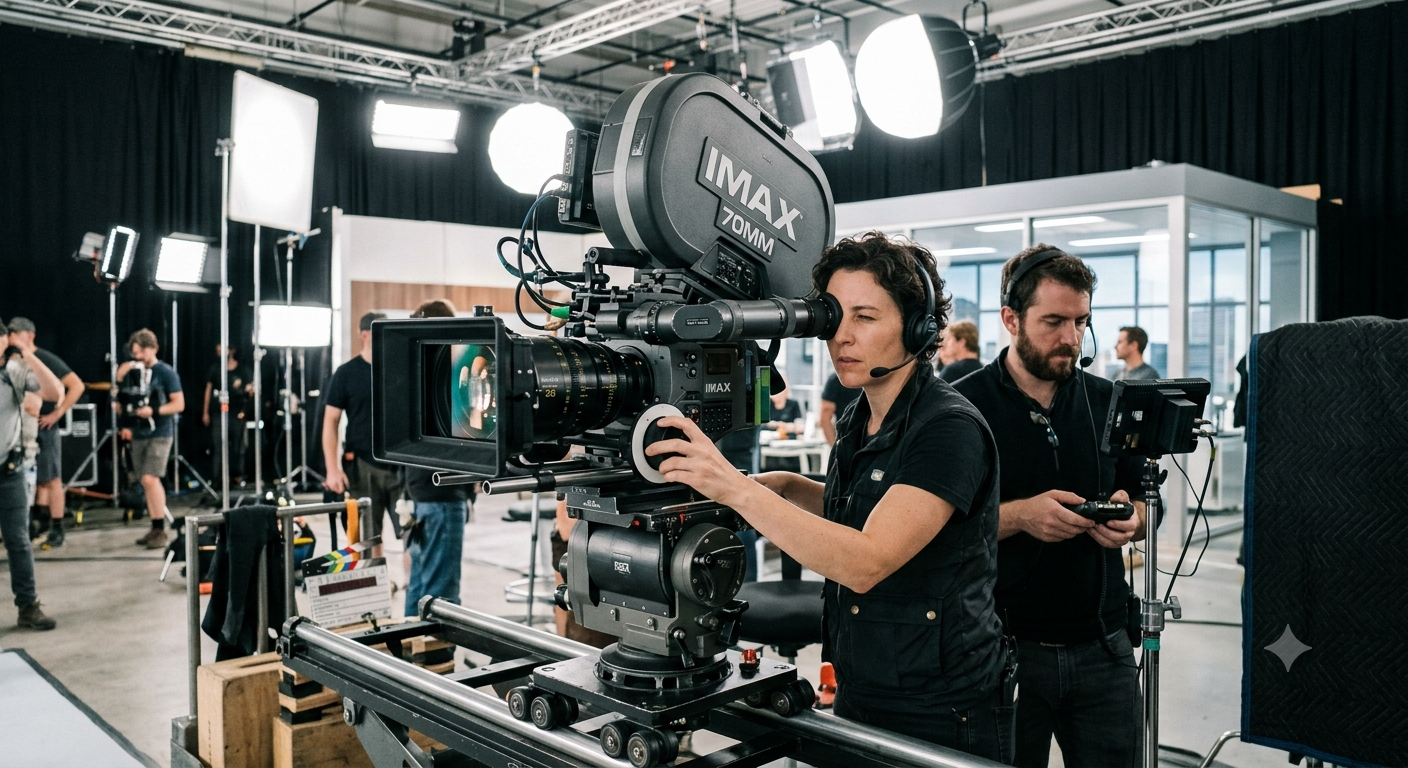
The primary difference between a film shot in IMAX and a regular movie begins long before the projection stage—it starts directly on the film set with the director’s choice of camera.
Traditional cinema relied for decades on the standard 35mm film format. Today, the vast majority of standard productions are recorded using high-performance digital cinema cameras that operate at sharp resolutions ranging from 4K to 6K.
True, native analog IMAX cameras utilize a massive 70mm film with 15 perforations per frame. Unlike standard film that moves vertically, IMAX film runs horizontally through the camera, creating an image area roughly ten times larger than traditional 35mm film.
Technical Note: In terms of digital equivalence, film experts estimate that an analog IMAX 70mm negative possesses a native resolution close to 18K. The sheer level of detail, textures, color accuracy, and depth captured by these mechanical giants is something that no conventional digital camera can perfectly replicate.
However, because these analog cameras are extremely heavy, noisy (the film whirs loudly through the gate), and expensive to operate, many modern directors opt for the newer IMAX-certified digital cameras (such as customized models of the ARRI Alexa or RED V-Raptor). While they do not reach the theoretical 18K of native roll film, they offer an image clarity that is absurdly superior to the industry average while perfectly maintaining the signature expanded aspect ratio of the format.
The Aspect Ratio: The End of Black Bars
Have you ever noticed those persistent horizontal black bars at the top and bottom of your screen when watching a movie on TV or in a regular theater? That format is the traditional widescreen aspect ratio (usually 2.39:1).
IMAX fundamentally breaks this formatting pattern. Theaters designed specifically for the format use a much more vertical, taller screen aspect ratio.
-
Standard Digital IMAX: 1.90:1 aspect ratio.
-
Original IMAX 70mm / Laser: 1.43:1 aspect ratio (which looks almost like a perfect square).
+---------------------------------------+
|         Original IMAX (1.43:1)        |
|  +---------------------------------+  |
|  |      Digital IMAX (1.90:1)      |  |
|  |  +---------------------------+  |  |
|  |  | Traditional Cinema (2.39:1|  |  |
|  |  +---------------------------+  |  |
|  +---------------------------------+  |
+---------------------------------------+
When a director like Christopher Nolan (Oppenheimer, Interstellar) or Denis Villeneuve (Dune) shoots a scene natively with IMAX cameras, they are capturing up to 40% more image at the top and bottom margins of the frame. When displayed in the correct theater, the image expands vertically, completely eliminating the black letterbox bars and filling the entire wall of the cinema. You literally see elements of the scenery, sky, and background action that simply disappear in the cropped, conventional cinema version.
Much Beyond the Image: The IMAX Immersive Sound System
It would be a massive mistake to limit the IMAX experience strictly to what your eyes can see. Audio plays an equally crucial role in achieving true cinematic immersion.
In conventional movie theaters, the sound system usually employs standard, well-distributed surround sound channels. However, the quality can suffer from audio dead zones or variations depending on exactly where you sit in the room.
IMAX’s sound system is entirely proprietary and custom-engineered for the exact acoustic geometry of each specific theater. It uses uncompressed audio channels perfectly aligned with lasers during daily calibrations. This means the audio tuning is so precise that a viewer can identify the exact spatial direction a subtle whisper or a booming explosion came from, regardless of whether they are sitting in the prime center row or the very last corner seat.
Furthermore, IMAX speakers utilize ultra-high-power subwoofers that operate at extremely low frequencies. You don’t just hear the bass; you feel your chest physically vibrate with the roar of an airplane engine or the thunderous impact of a crash on screen.
Theater Geometry and the “LieMAX” Phenomenon
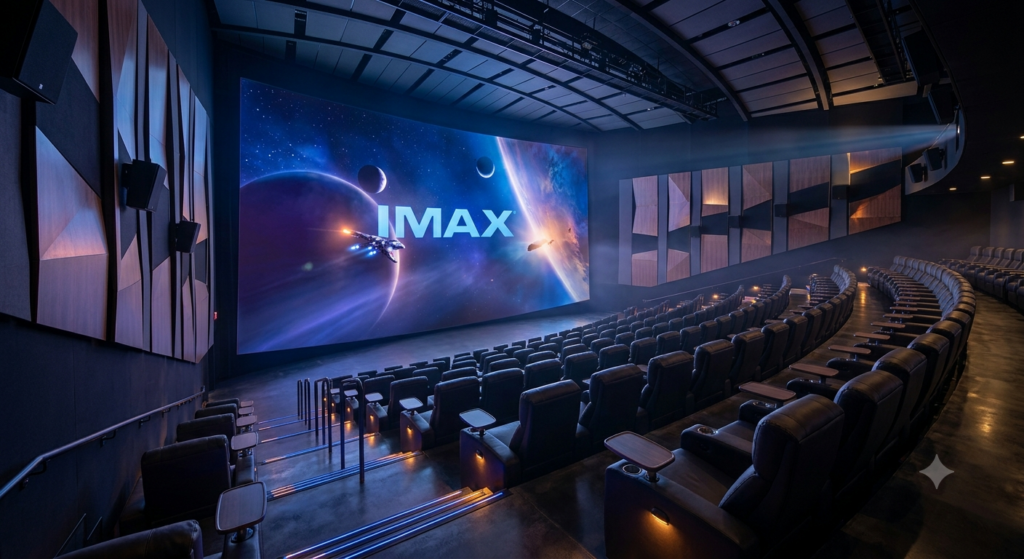
The structural architecture of a true IMAX auditorium is radically different from a traditional one. In a regular theater, the rows of seats are arranged linearly across a shallow incline, and the screen sits a considerable distance from the audience.
In an IMAX theater, the screen is slightly curved and extends literally from floor to ceiling and wall to wall. Additionally, the seating arrangement is much steeper and positioned significantly closer to the screen. The technical goal here is to place the viewer squarely inside the “immersion zone,” forcing the physical edges of the screen out of your immediate peripheral vision.
What is “LieMAX”?
With the rapid rise of the format’s popularity, the IMAX corporation began converting existing traditional multiplex screens into Digital IMAX theaters. While these converted rooms offer significantly better dual-projectors and sound engineering than standard screens, their physical screens do not possess the colossal 30-meter height of original, ground-up IMAX locations. The global cinephile community playfully dubbed these retrofitted mall conversions “LieMAX”. Even so, it is worth noting that the audio and video quality in these rooms still heavily outpaces the standard cinema experience.
Comparative Table: IMAX vs. Traditional Cinema
To make it much easier to visualize these distinct technical differences, we have prepared a direct comparison table below:
| Technical Feature | Traditional Cinema | IMAX Theater (Current Standard) |
| Image Resolution | Generally 2K or 4K Digital | 4K Laser (Digital) up to 18K (70mm Film) |
| Aspect Ratio | Widescreen (2.39:1) | Expanded (1.90:1 or 1.43:1) |
| Screen Geometry | Flat and distant from the audience | Curved, floor-to-ceiling, and brought forward |
| Audio Engineering | Industry-standard surround sound | Proprietary, laser-aligned uncompressed sound |
| Camera Requirements | Standard digital cinema cameras | Exclusive, high-scale native or certified cameras |
Comparative Graphic of Ratio and Field of View
(Below is a text representation of how the viewer’s peripheral vision is occupied in both environments)
[ TRADITIONAL THEATER ]                              [ IMAX THEATER ]
    ______________                                    _______________
   |  [  Screen  ] |                                 |              |
   |               |                                 |   [ SCREEN ] |
   |   Viewer      |                                 |   Viewer     |
   |_______________|                                 |______________|
(Vision overflows to the walls)    (Screen completely fills peripheral vision)
The short answer is: it entirely depends on the movie and how it was actively produced by the crew.
If you are heading to the theater to watch a lighthearted romantic comedy, an intimate dialogue-driven drama, or a conventional documentary, a traditional cinema or a standard VIP lounge will deliver exactly what you need without breaking the bank. These genres simply do not benefit from the massive visual scale, vertical screen space, or heavy-hitting audio design that IMAX specializes in.
On the other hand, investing in a premium IMAX ticket is worth every single penny if the film fits the following specific criteria:
-
It was shot natively using IMAX cameras: Renowned directors widely publicize and market when they use these heavy mechanical systems on set.
-
It features massive visual scale and complex sound design: Think space sci-fi movies, historical war epics, and blockbuster superhero films filled with practical effects.
-
It actively leverages the expanded aspect ratio: Keep an eye out for movies that intentionally shift screen sizes during major action sequences to reveal more visual content.
Conclusion
The core difference between movies filmed in IMAX and traditional ones is not just an elaborate marketing gimmick. It is a carefully managed technological chain that starts at the director’s camera lens on day one of filming and ends at the exact tilt and placement of the seat you are sitting in. It represents the absolute pinnacle of the collective, immersive experience that modern cinema can provide.
By understanding these core differences, you become a much more conscious consumer. You will know exactly when to save your money on a conventional ticket and when to comfortably secure the best seat in the house at an IMAX theater to witness an unforgettable visual spectacle.
Frequently Asked Questions (FAQ)
1. Was every movie shown in an IMAX theater actually filmed with IMAX cameras?
No. Many blockbusters are shot entirely with traditional cameras and go through a proprietary post-production process called IMAX DMR (Digital Media Remastering). While this upscales the image and optimizes the audio mix beautifully for large formats, the movie will not feature those coveted extra vertical image margins that native IMAX cameras capture.
2. Which is better: IMAX or traditional 3D?
IMAX 3D utilizes two separate, simultaneous projectors (one dedicated to each eye). This method entirely eliminates that dark, muddy, and dim aesthetic often associated with traditional 3D layouts that use only a single projector. If you enjoy three-dimensional content, IMAX offers a significantly brighter and cleaner presentation.
3. Where should I sit in an IMAX theater for the best possible experience?
Unlike regular cinema layouts where the very back row is highly coveted, the sweet spot in an IMAX theater is located in the lower-to-middle third or directly in the center of the auditorium. Sitting too far back distances your eyes from the screen, defeating the primary purpose of precluding your peripheral vision.
4. What is the main difference between IMAX and Dolby Cinema?
While IMAX focuses heavily on massive screen real estate, towering aspect ratios, and raw immersion, Dolby Cinema prioritizes extreme image contrast (using Dolby Vision HDR) and luxury seating arrangements. Both are incredible premium options, but IMAX remains the undisputed king of sheer scale and vertical field of view.