
Behind the Scenes of Location Sound Recording: Far Beyond Dialogue
When watching a compelling movie, an immersive television series, or a powerful documentary, our attention naturally zeroes in on the visual elements. The cinematography, vibrant costume design, dramatic lighting, and actor performances routinely claim all the praise for pulling us into a story. Yet an unwritten rule quietly governs the film industry: sound makes up at least half of the cinematic experience. Audiences will tolerate a slightly grainy image or unconventional camera angle, but poor, unintelligible audio causes viewers to turn off a video within seconds.
Despite its importance, location sound recording remains widely misunderstood. Many assume that capturing sound on set simply means pointing a microphone toward the actors to catch their lines. In reality, production sound mixing is a complex discipline that blends art, physics, and high-level technical skill. It is the practice of recording not just spoken words, but the texture of an environment, the three-dimensional space of a location, and the emotional weight of a scene. This guide steps behind the scenes of location sound recording to explore how sound crews operate, the specialized gear they use, and why capturing pristine audio goes far beyond simple dialogue.
The Invisible Role of Sound in Cinematic Storytelling
The primary objective of production sound recording is to construct a believable sense of reality—or a carefully controlled illusion. Unlike camera lenses, which are bounded by the edges of the frame, sound is omnidirectional and three-dimensional. Audio expands the visual universe far beyond what the audience can see on screen.
Consider a scene set inside a crowded city diner. The subtle clinking of silverware against ceramic plates, the low hum of distant conversations, and the sharp hiss of an espresso machine are not random background noises. Each layer adds tangible credibility to the setting. Without these sonic textures, the dialogue would sound dry, artificial, and detached from the physical room shown on screen.
Location sound teams must balance two conflicting goals: isolating human speech with extreme clarity while preserving the natural acoustic characteristics of the space. Achieving this balance provides the post-production team with clean audio stems that mix seamlessly alongside musical scores, ambient atmospheres, and sound effects.
Who Works on the Location Sound Crew?
Capturing clean audio in unpredictable environments requires flawless teamwork and coordination. On professional sets, the sound department works in close synchronization with the camera, lighting, and art departments.
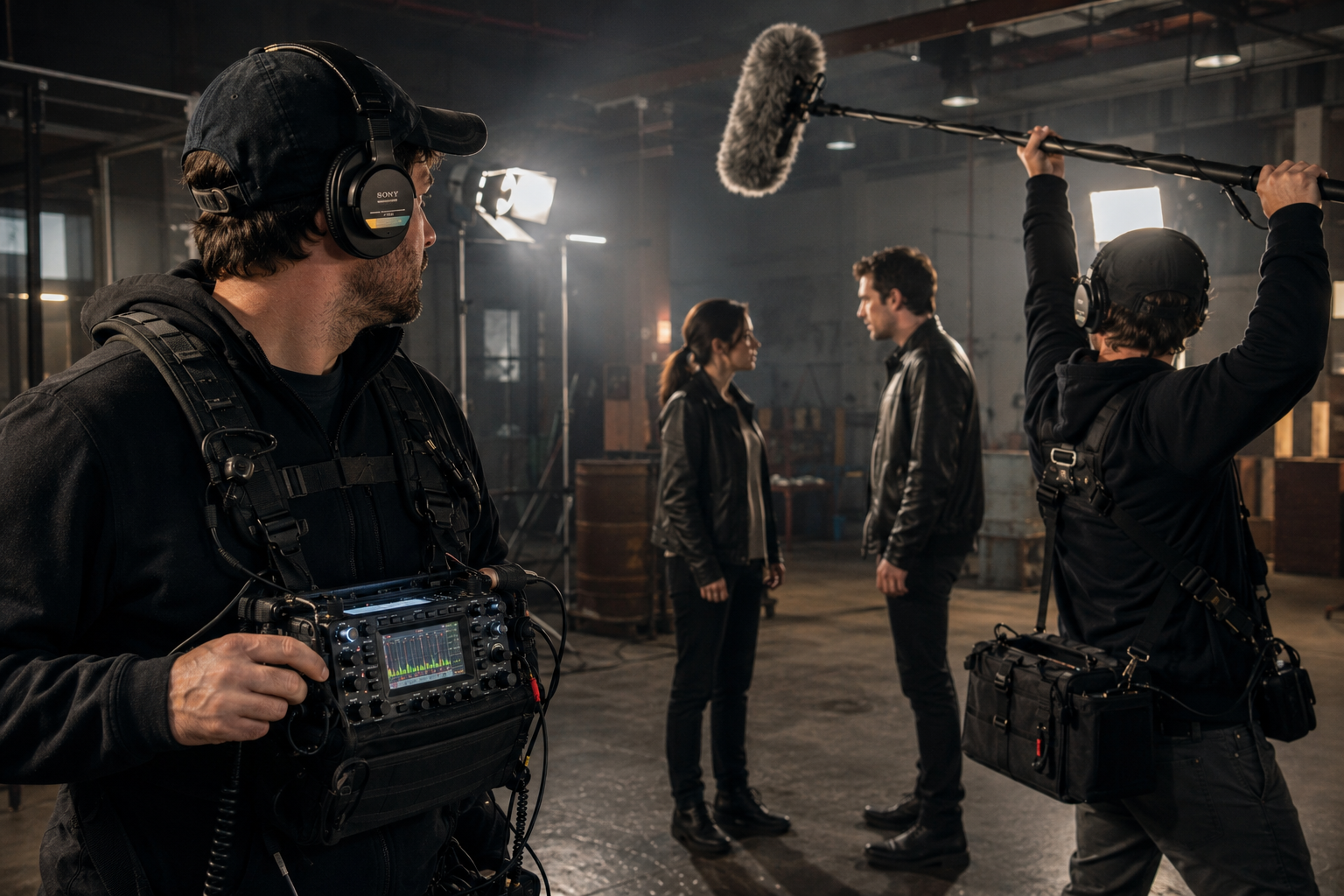
The Production Sound Mixer leads the department on set. Responsible for operating the field mixer and multitrack recorder, the sound mixer monitors audio levels, selects appropriate microphones for each scene, and ensures the signal remains free of distortion or unwanted noise. They make critical real-time decisions, advising the director when acoustic issues require another take.
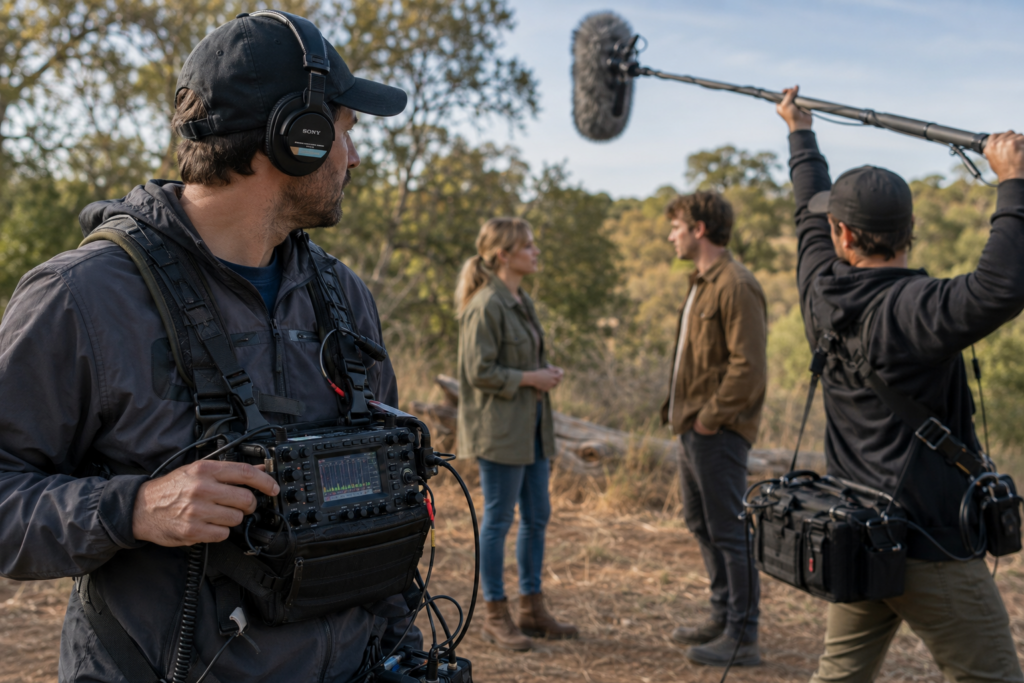
Working alongside the mixer is the Boom Operator. This role demands physical strength, precision, and deep narrative awareness. Holding a lightweight, carbon-fiber boom pole, the operator places the microphone as close to the actors as possible without allowing the capsule or its shadow to enter the camera frame. Boom operators must memorize the script and anticipate actor movements on the fly to keep every speaker perfectly on-axis.
On larger productions, a Sound Utility technician manages wireless lavalier systems, prepares batteries, routes cables, applies skin-safe tape to hide body mics under costumes, and distributes wireless monitoring receivers to the director and script supervisor.
Microphones and Essential Field Audio Gear
Capturing high-fidelity audio under changing conditions relies on specialized gear engineered to isolate voices and withstand field use.
Shotgun Microphones are the workhorses of location sound. Mounted on the end of a boom pole, these directional mics feature interference tubes that yield supercardioid or hypercardioid pickup patterns. They are highly sensitive to sound arriving directly in front of the capsule while attenuating unwanted noise coming from the sides and rear. This tight focus makes them ideal for capturing clear dialogue with natural warmth.
Lavalier Microphones are miniature capsules attached directly to an actor’s body or hidden within their wardrobe. Paired with wireless transmitters, lavaliers provide a consistent vocal signal regardless of where the actor turns or moves. The primary challenge with lavaliers lies in mounting them cleanly to prevent clothing rustle—the friction noise generated when fabric rubs against the microphone element.
Multitrack Field Recorders serve as the nerve center of the audio workflow. These rugged, battery-powered devices allow sound mixers to record each microphone onto an isolated track (known as iso tracks). Recording individual tracks gives dialogue editors maximum flexibility during post-production mixing.
Beyond Speech: Recording Room Tone and Wild Tracks
Capturing spoken lines is only part of the sound department’s responsibility on set. To build a seamless audio track during editing, the crew must record supporting audio elements that maintain continuity across cuts.
Room Tone is a continuous recording of the natural silence of a location, typically captured for 30 to 60 seconds after finishing a scene. Every room, street, or soundstage possesses a unique acoustic footprint created by building resonances, distant traffic, or environmental hums. Dialogue editors place room tone beneath the edits between an actor’s lines to smooth out background shifts, preventing jarring drop-offs in ambient noise during picture cuts.
Equally important are Wild Tracks. These are targeted recordings of specific sound effects captured on location without the camera running. Examples include door slams, footsteps on unique flooring, prop handling, or isolated actor reactions like laughs and sighs. Recording wild tracks on the actual set provides authentic sound effects that match the physical acoustic properties of the environment, reducing reliance on generic stock sound libraries.
Taming the Wild: Overcoming Real-World Acoustic Challenges
While shooting on a soundstage offers controlled acoustics, most productions film in real-world locations such as historic homes, bustling streets, or coastal beaches. In these uncontrolled settings, the sound crew wages a constant battle against environmental noise.
Wind Noise poses a major threat to field audio. Air moving across a microphone capsule creates low-frequency turbulence that ruins recordings. To counter this, sound crews enclose shotgun microphones inside aerodynamic windshield systems—often called “zeppelins”—and wrap them in synthetic fur covers known colloquially as “deadcats.”
Ambient Noise presents another hurdle. The hum of air conditioning units, refrigerator compressors, passing aircraft, traffic, and wireless RF interference can degrade dialogue quality. The sound crew must work diplomatically with location managers and directors to identify noise sources, silence non-essential appliances, or negotiate shooting breaks when external noise peaks.
How Quality Production Sound Shapes Post-Production
The quality of audio captured on set directly determines the speed, cost, and creative freedom of the post-production workflow. Clean location audio saves productions thousands of dollars and weeks of editing time.
When location recordings are clear and well-documented, dialogue editors and sound designers can focus on creative storytelling: layering Foley (re-recorded footsteps and prop handling), building immersive soundscapes, and mixing in spatial formats like Surround 5.1 or Dolby Atmos.
Conversely, noisy or distorted production audio forces productions to rely heavily on Automated Dialogue Replacement (ADR)—a process where actors re-record their lines in a studio while watching playback. While ADR is a valuable tool for fixing script changes or extreme noise, re-recorded lines often lack the raw emotional energy and spontaneity of the original performance captured live on set.
Best Practices for Capturing Pristine Audio on Set
Whether working on an independent indie film, a documentary, or commercial content, adopting professional location sound habits yields an immediate boost in production quality.
-
Prioritize Proximity: Place the microphone as close to the speaker’s mouth as safely possible. Physical proximity yields a higher signal-to-noise ratio, which improves clarity far more than buying expensive audio gear.
-
Manage Space Reflections: In reverberant rooms with hard surfaces, hang heavy furniture blankets or acoustic pads just outside the camera frame to absorb slap-back echo.
-
Monitor with Closed-Back Headphones: Never record audio blindly. Use flat-response, closed-back headphones to hear exactly what the microphone captures in real time.
-
Capture Room Tone Religiously: Make it a strict habit to record 30 to 60 seconds of silent room tone before wrapping a location setup.
-
Organize File Metadata: Name, slate, and log audio tracks accurately so editors can easily match production audio with camera takes during post-production.
Unlocking the Power of Location Sound
Location sound recording is a disciplined discipline sitting at the intersection of acoustic physics, creative storytelling, and problem-solving under pressure. Far beyond merely collecting dialogue, the production sound team captures the acoustic atmosphere of a story, building an invisible bridge that anchors the audience in the world on screen.
The next time you watch an intense cinematic scene, take a moment to listen closely to the subtle layers beneath the dialogue. You will hear the dedicated work of a sound crew who worked quietly behind the camera to turn physical acoustic vibrations into pure cinematic immersion.
Frequently Asked Questions (FAQ)
What is the difference between production sound and sound post-production?
Production sound refers to the audio captured live on set during filming, focusing on dialogue and location acoustics. Sound post-production occurs after editing is complete, encompassing dialogue cleaning, Foley recording, sound effects design, music composition, and final re-recording mixing.
What is the best microphone for location dialogue?
Shotgun microphones (with supercardioid or hypercardioid polar patterns) mounted on a boom pole are the industry standard for outdoor and spacious indoor scenes. For small rooms with heavy echo, specialized small-diaphragm hypercardioid condenser mics are preferred, while wireless lavaliers serve as secondary sources or hidden alternatives.
What is room tone, and why is it essential?
Room tone is a 30- to 60-second recording of the ambient sound profile of a quiet set. Dialogue editors use it to fill background gaps between spoken phrases during editing, creating a seamless background track that prevents distracting drops in noise levels.
Can bad location audio be fixed in post-production?
Modern audio restoration tools and AI-assisted plugins can reduce consistent background noise and minor room reflections. However, heavy noise reduction often introduces phase artifacts and hollows out human vocal frequencies. Capturing clean audio on set remains the gold standard for professional productions.