
How Fight Scenes Are Made in Modern Cinema
How Fight Scenes Are Made in Modern Cinema, when watching an adrenaline-fueled action sequence on the silver screen—whether it is a visceral brawl in a rain-slicked alleyway or an epic martial arts confrontation—it is easy to forget that every single second on screen is the result of months of painstaking preparation. Contemporary cinematic combat has evolved dramatically over recent decades. Long gone are the days when obvious punches pulled miles away from an actor’s face and generic, exaggerated sound effects were enough to satisfy moviegoers.
Today’s audiences demand realism, spatial clarity, and tactile impact. But how exactly are these complex sequences designed, rehearsed, and shot without endangering the physical safety of the cast? The answer lies in an interdisciplinary artistic engine that combines biomechanics, visual psychology, rigorous physical conditioning, and cutting-edge audiovisual technology. Below, we step behind the curtain to reveal how fight scenes are produced in the modern era of filmmaking.
The Evolution of Cinematic Combat: From Visual Theater to Visceral Realism
To understand modern action cinema, one must look at its recent trajectory. In the 1980s and 1990s, mainstream Western cinema relied heavily on rapid cuts, ultra-tight framing, and obvious stunt doubles stepping in during the moment of impact. While iconic classics were born in this era, the physical logic of combat often felt theatrical or implausible.
The major paradigm shift arrived through the influence of Hong Kong martial arts cinema—popularized by pioneers like Jackie Chan and Bruce Lee—which prioritized wide framing, physical continuity, and real-time execution of movement. At the turn of the millennium, landmark productions like The Matrix introduced HK-style wirework (wire-fu) and required top-tier actors to undergo months of intensive martial arts training.
In recent years, groundbreaking franchises such as John Wick, The Raid, and Atomic Blonde have redefined industry standards once again. The current trend places a premium on believable physics, visible character exhaustion, and uninterrupted, fluid camera work.
The Essential Role of the Stunt Coordinator and Action Crew
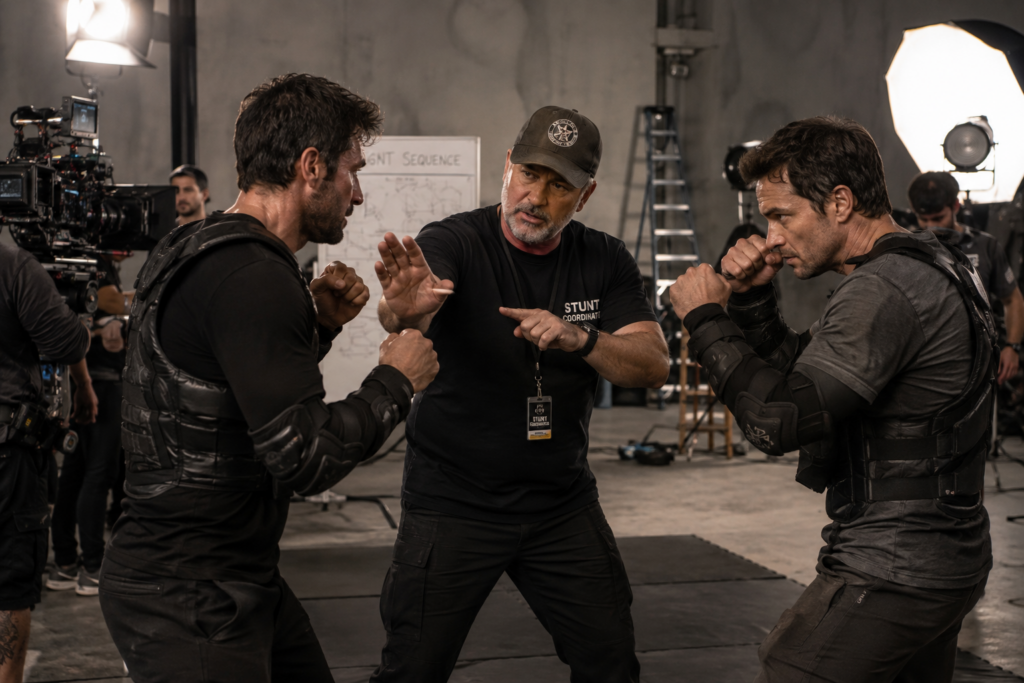
At the heart of every legendary action sequence is the stunt team, led by the stunt coordinator and the second-unit director. In modern filmmaking, these creative professionals have earned unprecedented artistic autonomy, serving as true architects of physical movement.
A stunt coordinator analyzes the script not merely to decide who hits whom, but to understand the psychological context of the narrative. Every punch, block, and throw must reflect the emotional state and background of the fighters:
-
Desperate Combatants: Feature erratic, violent, and instinctual movements born out of pure survival.
-
Trained Military or Assassins: Execute surgical, energy-efficient strikes, weapon retention techniques, and tactical positioning.
-
Exhausted Protagonists: Exhibit physical instability, heavy breathing, and creative use of environmental objects to stay alive.
Translating dramatic character traits into precisely synchronized physical gestures is what elevates a basic brawl into a compelling visual story.
Pre-Visualization (Stunt Previs): The Action Blueprint
Long before an actor steps onto the actual filming set, the fight sequence has already been shot, edited, and perfected multiple times through a process known in the industry as Stunt Previs (Pre-Visualization).
During this crucial phase, the stunt team gathers in a rehearsal gym equipped with mats and handheld cameras. They record the complete fight sequence, testing different combinations of strikes, lens angles, and pacing. This raw footage is then edited together with temporary sound effects and music before being presented to the main director.
Stunt Previs operates as a 3D architectural blueprint. It allows the filmmakers to spot optical flaws, identify “dead angles,” and optimize camera positioning ahead of time. This meticulous prep work saves hundreds of hours and millions of dollars during actual production.
Intensive Actor Training and the Physiology of Muscle Memory
The modern preference for longer, wider camera takes has changed how lead actors prepare for roles. Performers like Keanu Reeves, Charlize Theron, and Tom Cruise dedicate months to daily physical conditioning prior to principal photography, practicing disciplines like Brazilian Jiu-Jitsu, Judo, Krav Maga, and tactical firearms handling.
The primary goal of actor fight training is not to turn a Hollywood star into a competitive fighter, but to build deep muscle memory. When mechanical movements become automatic, the actor can focus entirely on dramatic performance without hesitating before a strike.
When actors perform their own core maneuvers, directors enjoy the freedom to keep the camera close to their faces, delivering authenticity and emotional intimacy. For high-risk maneuvers—such as hard falls onto hard surfaces or high-elevation drops—professional stunt performers step in to execute the action safely.
Camera Techniques and Framing: Crafting the Illusion of Contact
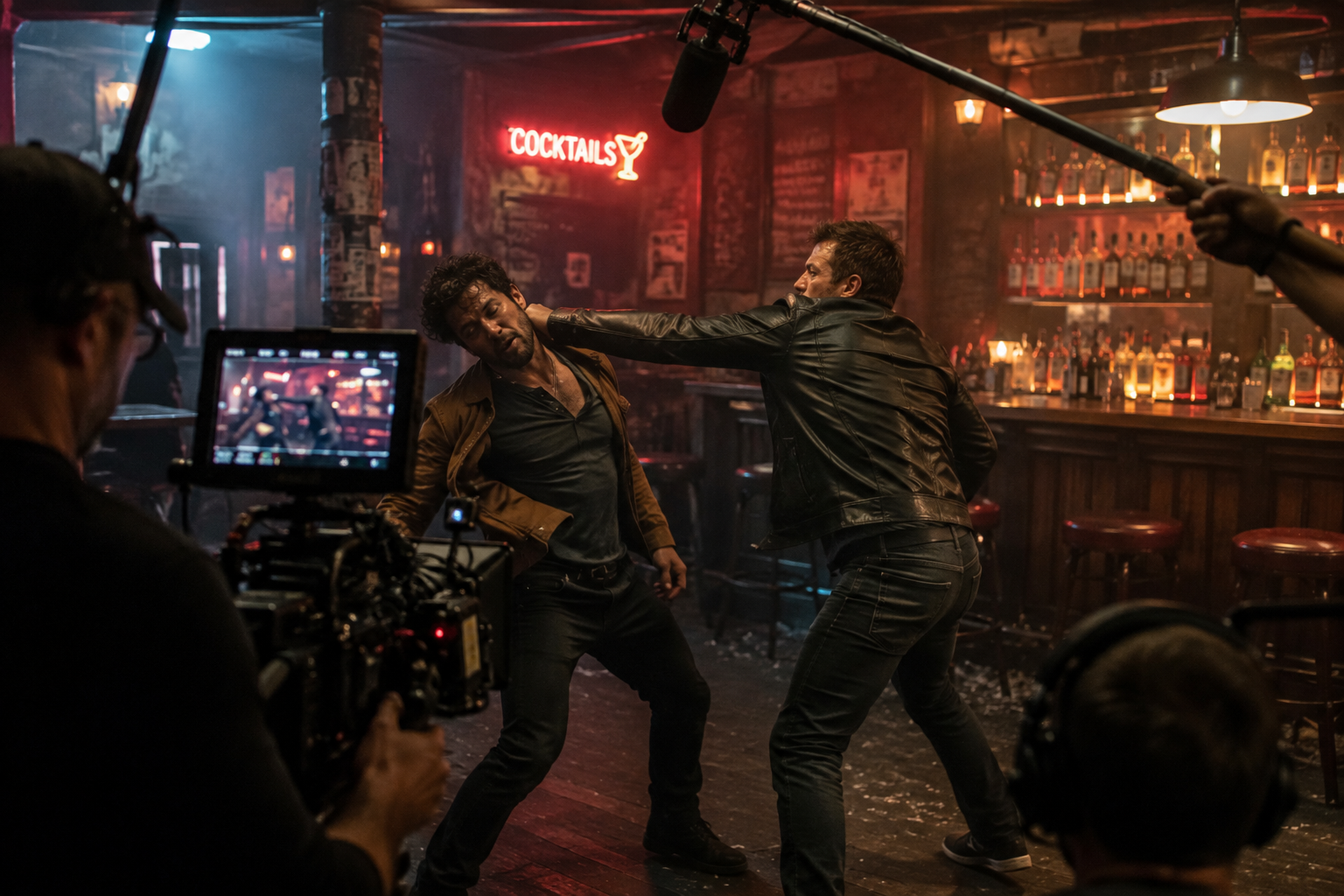
On a movie set, a real punch rarely touches a co-star’s face. The illusion of crushing violence is engineered right at the intersection between the camera lens angle and the movement of the performers.
If an actor throws a cross-punch from left to right, the camera is positioned on the side opposite the imaginary impact point. The empty space between the fist and the opponent’s jaw remains hidden within the camera’s blind spot. At the precise fraction of a second when contact “occurs,” the receiving actor snaps their head back, while the camera operator applies a controlled micro-shake. The viewer’s brain automatically fills in the blanks, perceiving a crushing blow.
Shaky Cam vs. Long Takes: Choosing the Visual Language
The choice of camera technique shapes the atmospheric tone of an action sequence. Comparing the two dominant modern styles reveals vastly different visual experiences:
| Camera Style | Key Technical Features | Impact on the Viewer |
| Shaky Cam / Fast Cuts | Rapid handheld movement, tight close-ups, frequent edits. | Simulates panic, chaos, and documentary-style urgency. |
| Long Takes / Plan-Séquence | Extended shots without visible cuts, heavy use of gimbals/Steadicams. | Delivers spatial clarity, deep immersion, and showcases real physical talent. |
Editing and Montage: Sculpting the Psychological Pace
The editing suite is where the ultimate rhythm of an action scene is sculpted. Editors specializing in action cinema understand that cutting is not just about changing angles; it is about guiding the audience’s psychological state.
A vital principle in modern action editing is focal point continuity (eye-tracking). When a punch is thrown on the left side of the screen, the subsequent cut must direct the viewer’s eye immediately to the point where the reaction occurs. If the audience has to search the frame for the impact point, the momentum of the sequence is shattered.
Furthermore, editors often employ frame removal (cutting 2 to 3 frames out of a movement) to make a strike look significantly faster and more forceful without looking unnatural to the naked eye.
The Power of Sound Design: Foley and Auditory Weight
If you watch a legendary action scene with the sound muted, you will quickly notice that it loses much of its visceral punch. Sound design is responsible for turning a light theatrical touch into a bone-crunching impact.
Foley artists and sound designers construct action audio in layers within recording studios:
-
Movement Sounds: The subtle rustle of heavy leather, denim, or tactical gear as fighters shift their weight.
-
Hits and Impacts: A blend of real punches landing on slabs of raw meat layered with heavy, low-frequency sub-bass thuds.
-
Bone Breaks and Injury: The sound of snapping thick celery sticks or cracking walnuts close to high-definition microphones.
When mixed seamlessly with the musical score, these auditory cues ensure that every strike is felt viscerally by the audience.
Visual Effects (VFX) and On-Set Safety Controls
Despite the current push for practical realism, Visual Effects (VFX) remain an indispensable component of modern action filmmaking, functioning primarily as an invisible safety network.
Rather than replacing real performers with digital doubles, modern VFX work is often used to erase safety equipment from the frame. Wire rigs, safety harnesses, crash mats, and camera crew reflections are digitally removed in post-production. Additionally, for safety reasons, blades on knives and swords used in close combat are often rubber props or blunted hilts, which are then enhanced with digital metallic sheen, reflections, and blood effects after the scene is shot.
How Fight Scenes Are Made in Modern Cinema- Conclusion
The creation of modern fight scenes in cinema is a masterclass in collaborative artistry. What appears on screen as an outburst of chaotic violence is, in reality, a meticulously planned dance that brings together the physical dedication of actors, the bravery of stunt performers, the technical precision of camera operators, and the creative genius of editors and sound engineers.
By respecting the audience’s intelligence through clear spatial storytelling, well-rehearsed choreography, and thoughtful craft, modern filmmakers have transformed cinematic combat into one of the purest and most captivating forms of visual expression.
Frequently Asked Questions (FAQ)
How Fight Scenes Are Made in Modern Cinema
How do actors avoid getting hurt during movie fight scenes?
Injury prevention is achieved through weeks of repetitive choreography rehearsal, the strategic use of professional stunt doubles for high-risk stunts, hidden protective padding under costumes, and the use of flexible prop environments (such as sugar glass and breakaway foam furniture).
What does the term “Stunt Previs” mean in film production?
“Previs” stands for pre-visualization. It refers to a preliminary video recording of a fight scene produced by the stunt team prior to official filming. It acts as a prototype to test camera angles, movement flow, pacing, and editing cuts before bringing in the main cast and crew.
Why do punch sound effects in movies sound so different from real life?
In reality, physical punches yield soft, dull thuds. Movies rely on stylized sound design and Foley work to amplify the emotional weight of combat, layering sounds like meat impacts, sub-bass tones, and leather snaps to convey force dynamically to the audience.
What is the difference between a stunt double and a stunt coordinator?
A stunt double is an individual performer who physically steps in to execute dangerous maneuvers in place of an actor. A stunt coordinator is the department head responsible for designing the choreography, enforcing safety protocols, managing the stunt budget, and leading the action crew.