
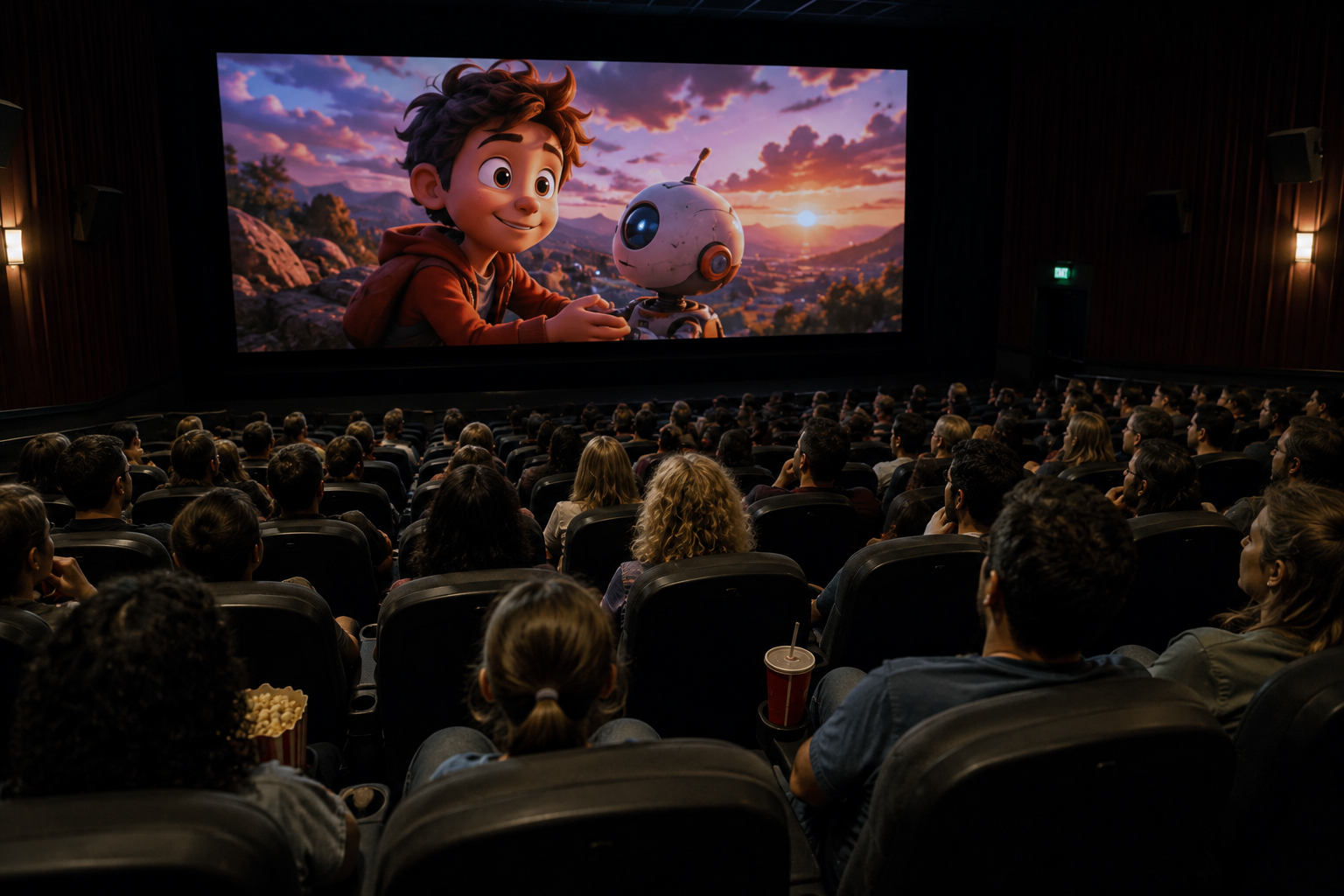
Behind the Scenes of Animated Movie Production
When watching an emotional animated film in theaters,
it is easy to become captivated by the fluid movements, breathtaking scenery, and emotional depth of the characters.
However, behind every single minute shown on the big screen lie years of hard work, dedication,
and intense collaboration among hundreds of artists, writers, voice actors, and computer graphics engineers.
Unlike live-action filmmaking, where cameras capture pre-existing physical reality,
animation requires absolutely everything to be created from scratch.
Every leaf swaying in the wind, every single strand of a character’s hair,
and every reflection of light on a puddle of water requires meticulous artistic decisions and complex technical solutions.
In this comprehensive guide, we will dive deep behind the scenes of major animation studios,
To explore every stage of the animated movie production pipeline, revealing how a simple idea evolves into a cinematic masterpiece.
1. Pre-Production: Where the Story and Artistic Vision Are Born
Everything starts with an idea. The pre-production phase serves as the foundation of any animated project and is typically the longest stage of development,
Often lasting anywhere from two to three years. It is during this period that the core concept takes shape and builds its narrative structure.
Screenwriting and Concept Development
Writing a script for an animated feature is an intensely iterative process.
Unlike live-action films, where actors can improvise on set during shooting, an animated script must be thoroughly tested, story-boarded,
and revised prior to visual production to prevent massive waste of time and financial resources.
Storyboard and Animatic: The First Draft of the Film
With the approved script in hand, a team of storyboard artists translates the written text into thousands of sequential drawings resembling a comic book.
These panels outline camera angles, framing, staging, and primary character actions.
Next, the storyboard panels are assembled onto a video timeline accompanied by temporary dialogue and scratch sound effects,
creating what the industry calls an animatic (or story reel).
The animatic is essentially the first rough cut of the entire movie.
It enables directors and editors to fine-tune pacing, comedic timing, and scene transitions long before any 3D models or final artwork are produced.
2. Visual Design: Building Worlds and Characters from Scratch
While the screenplay is continuously refined, the art department works diligently to establish the visual identity of the production.
Concept artists and character designers sketch hundreds of exploratory drawings testing various artistic styles, proportions, costumes, and color palettes.
Character Design and Color Scripts
-
Character Design: Artists create turnarounds showing the character from the front, profile, and back views, alongside expression sheets that guide animators on how facial features move.
-
Color Script: The art director creates a simplified visual sequence of key illustrations mapping out the color palette and lighting design across the entire story. The color script establishes the emotional tone for each sequence, indicating whether a scene should feel warm, gloomy, or tense through color choices.
3. Voice Recording and Early Sound Design
In Western animation production (such as studios like Disney, Pixar, and DreamWorks), recording the original voice cast occurs before actual animation work begins.
This sequence is critical for achieving realistic facial animation and lip synchronization.
Voice actors record their performances in sound booths, guided by directors toward highly expressive delivery.
Frequently, reference cameras capture the actors’ facial expressions during recording sessions.
These video references serve as invaluable guides for animators,
Who subtly integrate the actor’s real-life gestures, blinks, and lip movements into the digital character’s performance.
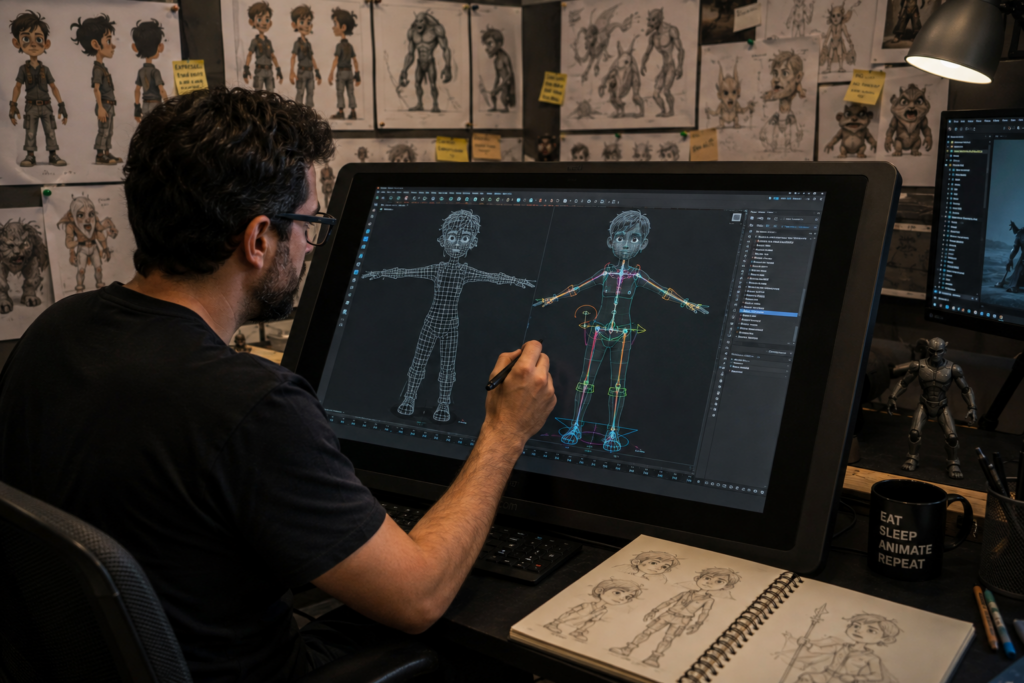
4. 3D Modeling and Rigging: Constructing the Digital Framework
Once conceptual designs are approved and audio tracks are recorded, production transitions into the technical phase of building digital assets using 3D software.
Three-Dimensional Modeling
3D modelers transform two-dimensional artwork into digital sculptures.
Using polygonal meshes, they meticulously build characters, props, vehicles, and entire environments, ensuring proportions look correct from every camera angle.
Rigging: The Digital Skeleton
A static 3D model cannot move on its own. To enable movement, rigging specialists (riggers) construct an invisible virtual skeleton beneath the model’s surface.
They insert digital bones, joints, and interactive control handles.
A main character’s facial rig in a feature animated film can feature thousands of individual control points,
Empowering animators to deform eyelids, cheeks, and lips to generate infinitely subtle human expressions.
5. The Animation Stage: Breathing Life and Soul into Characters
The animation phase is where acting truly takes place.
Animators are essentially actors who communicate through digital software or paper.
They manipulate the control handles of the rig to pose characters frame by frame.
Standard cinema runs at 24 frames per second (fps).
This means that for every single second of screen time, animators must meticulously set the positions and exact timing across 24 individual images.
To deliver believable performances, animators apply the classic 12 Principles of Animation (such as squash and stretch, anticipation, staging, and timing).
Animators frequently film themselves acting out scenes in front of mirrors or webcams to study real-world physics and body language before translating those performances into their software.
6. Simulating Visual Effects, Cloth, and Hair Dynamics
Animating every individual strand of hair or fold of clothing by hand would be humanly impossible and financially unfeasible.
This is where simulation and visual effects (VFX) artists step in.
Computational Physics and Dynamics
Specialized technical departments utilize physics-based simulation engines to compute how heavy fabrics sway when a character walks,
How hair reacts to wind gusts, or how water splashes in a stormy ocean.
Furthermore, VFX artists build complex natural phenomena such as fire, smoke, explosions, dust, and snow.
Each element demands custom algorithms to ensure realistic motion that seamlessly matches the film’s stylized artistic direction.
7. Lighting and Rendering: Painting with Light
Lighting in 3D animation operates much like cinematic photography in live-action.
Lighting artists position virtual light sources within the 3D scene to guide the viewer’s eye, create spatial depth, and reinforce the emotional mood dictated by the color script.
The Render Farm and Final Processing
Once a scene is fully animated, simulated, and lit, it enters the rendering phase.
The render engine calculates how virtual rays of light interact with surfaces, textures, shadows, and reflections across every object in the frame.
Because these mathematical computations require immense processing power, animation studios rely on render farms—supercomputers containing thousands of server nodes running continuously. Even with this massive computing infrastructure, rendering a single complex frame of a feature film can take dozens of hours to finalize.
Animated Movie Production- Conclusion
Producing an animated movie is an extraordinary synthesis of traditional fine art, dramatic performance, and cutting-edge computer engineering.
Every frame that graces the screen represents the culmination of thousands of creative decisions made by a passionate team of artists and technicians.
Understanding the intricate behind-the-scenes journey—from the initial paper napkin sketch to the final rendered frame—deepens our appreciation for animation as one of the most rich, complex, and magical storytelling mediums in modern cinema.
Frequently Asked Questions (FAQ)
How long does it take to produce a major animated feature film?
On average, a major 3D animated feature film from top studios (like Pixar, Disney, or DreamWorks) takes between 4 and 5 years to complete, spanning from original concept development to final post-production.
What is the difference between 2D, 3D, and Stop-Motion animation?
2D animation creates the illusion of movement using flat two-dimensional drawings (hand-drawn or digital).
3D animation uses digital three-dimensional models manipulated within virtual environments.
Stop-motion animation uses physical puppets and sets photographed one frame at a time.
Why is voice acting recorded before the animation process starts?
Voice tracks are recorded beforehand so animators can accurately synchronize facial lip movements with the actor’s exact cadence and adapt body language timing to match the natural rhythm and emotion of the audio.
Do animators really use mirrors while working?
Yes! It is extremely common to see mirrors at animators’ workstations.
Animators use their own faces as real-time reference to analyze how facial muscles shift when expressing emotions like surprise, anger, joy, or subtle hesitation.