
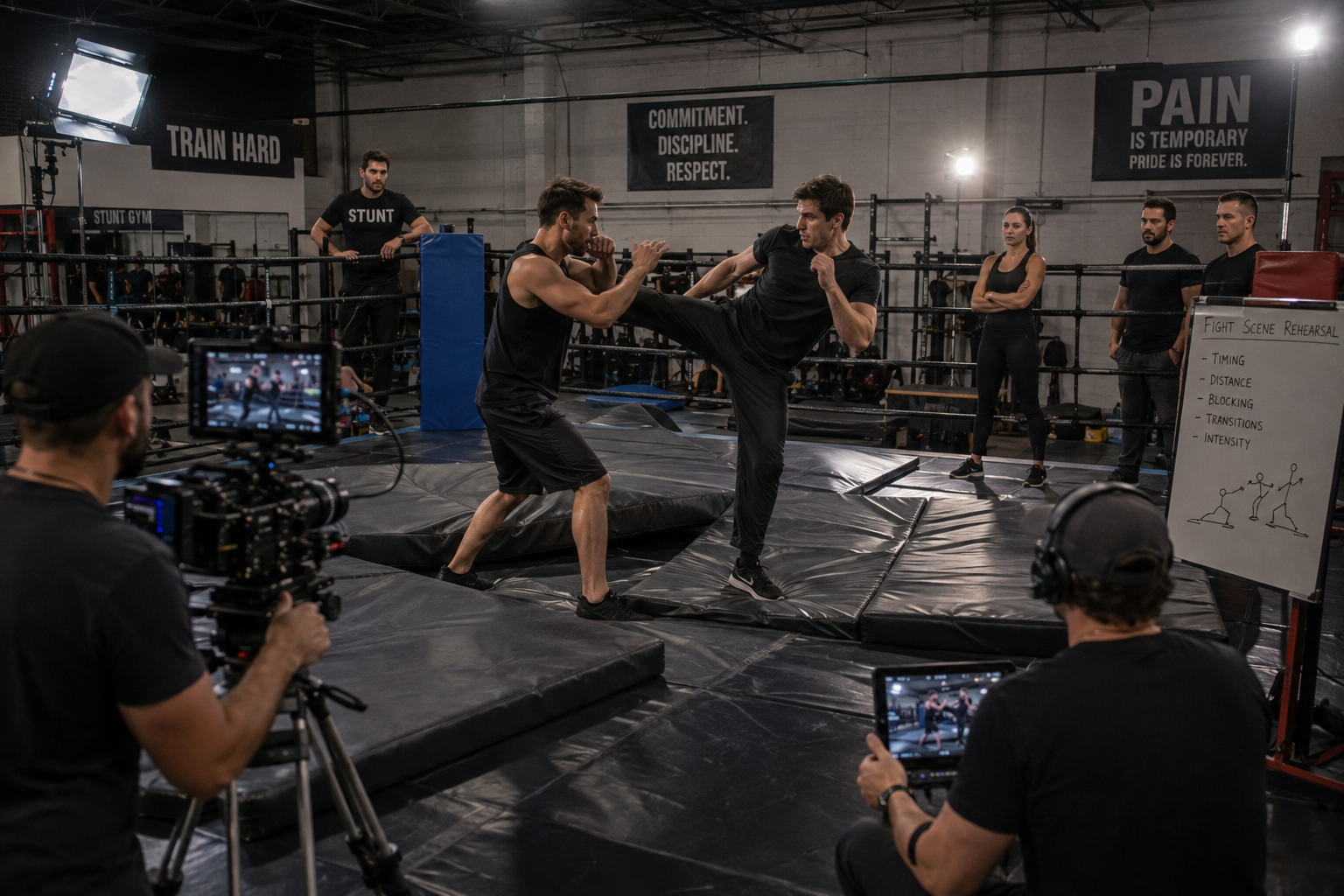
How Action Movie Fight Choreography Rehearsals Work
How Action Movie Fight Choreography Rehearsals Work.
A thrilling fistfight in a narrow alleyway, a sword duel on a rooftop, or a gun-fu shootout sequence with seamless timing looks like pure, instinctual chaos on the cinema screen. Yet, what audiences experience as an explosion of raw adrenaline and fluid violence is, in reality, a meticulously calculated dance.
Behind the scenes of modern action cinema, there is no room for improvisation. Every punch dodged by millimeters, every fall across a table, and every knife dodge is the result of weeks or even months of exhaustive rehearsals. If the production team fails during preparation, the outcome can range from an unnatural-looking fight scene to severe accidents on set.
To transform script descriptions into memorable and safe action sequences, film productions rely on specialized stunt teams and action coordinators. Below is a detailed look into how fight choreography rehearsals work to bring cinema’s greatest battles to life.
1. The Conceptual Phase: Designing the Combat Narrative
Long before actors step into the rehearsal room, the process begins on paper and within the creative minds of the director and the fight coordinator. The primary objective during this initial stage is to understand the narrative purpose of the battle.
In high-level filmmaking, an action scene is never just filler; it must tell a story, reveal a character’s emotional state, and drive the plot forward.
During conceptualization, the action coordinator evaluates several critical variables:
-
Who are the fighters? A trained military operative fights with clean efficiency, whereas a desperate survivor fights frantically and unpredictably.
-
What is the environment? A kitchen provides everyday items as improvised weapons; a tight hallway forces short-range strikes and body checks.
-
What is the martial arts style? The team decides whether the fight will be grounded in Kung Fu, Muay Thai, Brazilian Jiu-Jitsu, Krav Maga, or the popular hybrid style known as Gun-Fu (combining close-quarters firearm tactics with martial arts).
With these guidelines set, the coordinator and senior stunt performers begin crafting basic movement phrases inside the stunt gym.
2. Stunt Previs (Pre-Visualization): The Video Blueprint
One of the most vital innovations in modern action cinema is the Stunt Previs (stunt pre-visualization). A previs is a test video of the entire action sequence, shot and edited by the stunt team within the rehearsal facility long before filming begins on the main set.
Stunt performers wear comfortable workout gear, use lightweight foam or wooden props, and record the complete fight using handheld cameras or smartphones.
Why Is Previs Essential?
-
Director Approval: The director can see exactly how the scene flows, making adjustments to pacing, intensity, or strikes before spending budget on location.
-
Camera Framing: The camera crew determines which angles best conceal the lack of real contact in punches while maximizing the perception of speed.
-
Editing Guide: The film editor uses the previs as a reference map during post-production to cut between takes at the precise moments of peak impact.
3. Physical Conditioning and Cast Training
Once the director approves the stunt previs, it is time to bring the actors into the training facility. Depending on the complexity of the project and the actor’s starting fitness level, this training stage can last anywhere from four weeks to six months.
The goal is not to turn an actor into a grandmaster overnight, but rather to build muscle memory and the physical endurance needed to repeat the same high-energy sequence dozens of times under hot studio lights.
Core Training Pillars
-
Conditioning and Flexibility: High-intensity cardiovascular workouts, core strengthening, and joint mobility exercises prevent muscle strains and exhaustion.
-
Footwork and Stance: Actors learn how to move with balance, keeping their center of gravity stable so they can react swiftly to staged attacks.
-
Striking and Reaction Mechanics: Extensive repetition of punches, kicks, dodges, and reactions to hits teaches actors how to throw their body backward to simulate force without taking damage.
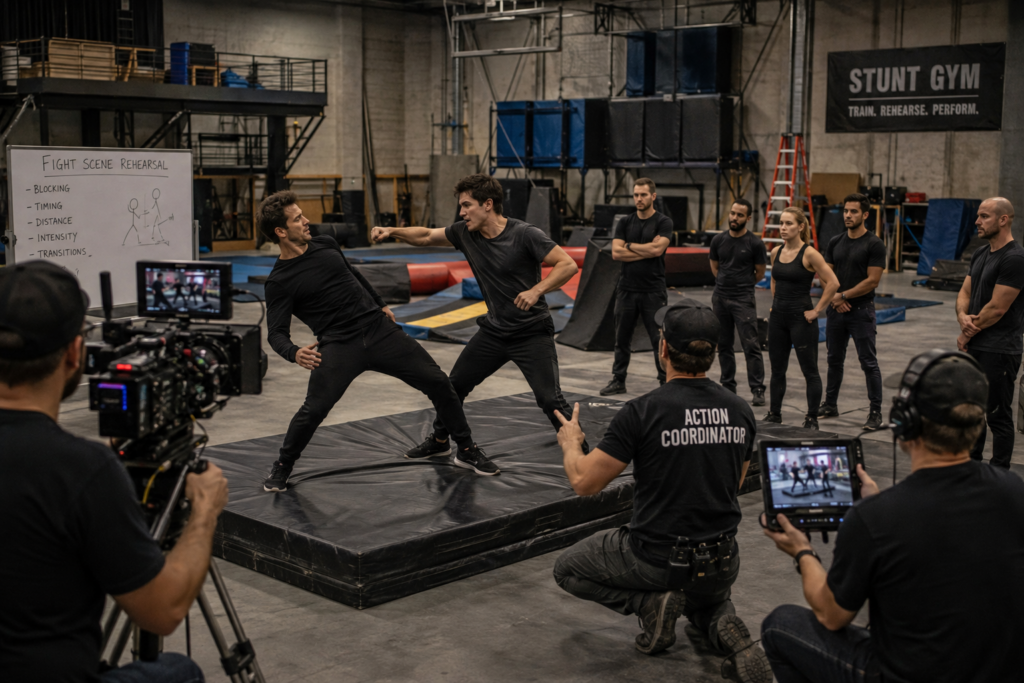
4. Breaking Down the Fight: Segmenting Choreography into Blocks
Attempting to memorize a three-minute fight sequence all at once is both inefficient and dangerous. Therefore, rehearsals follow a strict methodology by breaking the sequence down into small operational blocks of three to five movements.
-
Quarter Speed (25%): Actors run through the sequence in slow motion to memorize the exact order of strikes, foot placements, and hand positions.
-
Half Speed (50%): The focus shifts toward timing. Actors and stunt doubles refine safety margins, ensuring a consistent 4-to-6-inch gap of empty air between the strike and the opponent’s face.
-
Full Speed (100%): The choreography is executed at full performance speed with maximum dramatic energy, maintaining absolute physical control to stop short of real impact.
The golden rule of fight rehearsals remains absolute: speed must never compromise control. Visual impact is created through dramatic commitment and camera angles, not physical force.
5. Safety Protocols: Prop Weapons and Protective Gear
Protecting the physical well-being of actors and stunt performers is the top priority for any action coordinator. A single injury can halt production for weeks, costing hundreds of thousands of dollars.
Throughout rehearsals, safety is enforced through specialized gear and controlled environments:
-
Hidden Pads: Performers wear thin, high-absorption gel pads on knees, elbows, and along the spine, specifically designed to fit discreetly under costumes.
-
Rubber and Silicone Props: In rehearsals and close-up filming, swords, knives, batons, and firearms are flexible replicas made of dense rubber or resin to prevent accidental cuts or punctures.
-
Crash Mats: Throwing techniques and falls are practiced repeatedly on thick, high-density crash mats. As performers gain confidence, mats are downsized to thinner versions until transitioning to the actual set surface.
6. Aligning with the Cinematographer: Master of Camera Angles
Even the most impressive fight choreography can look weak if captured from the wrong angle. In the final phase of rehearsals, the Director of Photography (DP) and camera operators join the stunt team to align visual techniques with physical movements.
Because movie punches do not actually connect with an opponent’s face, the illusion of impact relies entirely on the camera’s sightline.
The camera must be positioned so that the attacker’s fist passes directly between the camera lens and the defender’s face. From this specific perspective, the invisible safety distance vanishes on screen, creating the convincing illusion of a crushing blow. The camera operator also rehearses dynamic movement, panning and stepping in rhythm with the fighters to amplify the energy.
Conclusion
Rehearsing action movie fight choreography is an intricate discipline that combines the artistic precision of classical dance, the physical rigor of martial arts, and the meticulous science of risk management. What appears on screen as an unpredictable clash of violence is, in truth, an extraordinary accomplishment of human coordination built movement by movement.
Through months of dedication in training facilities, the development of stunt previs, and the skilled work of stunt professionals, filmmakers deliver breathtaking action while ensuring every team member finishes the day safely.
Frequently Asked Questions (FAQ)
How long does it take to prepare fight scenes for an action movie?
It depends on the project’s scope. For standard action films, preparation takes 2 to 4 weeks. For heavy martial arts films (such as John Wick or The Matrix), actors and stunt performers train for 3 to 6 months prior to filming.
Do actors perform all of their own fight scenes?
While many actors train extensively to perform close-up fight sequences, professional stunt doubles perform maneuvers involving high risk, such as major falls, vehicle crashes, complex gymnastics, or hard impacts.
What is a stunt previs in filmmaking?
A stunt previs is a pre-visualization test video of an action sequence created by the stunt team during rehearsals. It serves as a visual layout for the director to approve choreography, camera angles, and pacing before main production begins.
How do actors avoid getting hurt from punches in movies?
Punches do not make real contact. Actors maintain a safety buffer of several inches, and the perception of impact is created through precise camera angles, realistic actor reactions, and added sound effects in post-production.