
How Car Scenes Are Filmed Without Putting Actors at Risk
When watching an intense dialogue inside an automobile or a police chase through congested city streets.
Viewers rarely stop to consider who is actually driving the vehicle.
On screen, the actor gesticulates, maintains eye contact with the passenger.
Shifts gears, and reacts dramatically to the plot while the car weaves through traffic at high speeds.
In reality, attempting to drive for real while delivering emotional dialogue under studio lights and directly into a camera lens would be a recipe for disaster.
Distracting a driver for even a fraction of a second is extremely dangerous.
Yet, modern cinema consistently creates the illusion of driving without ever placing the cast in real danger.
Crafting this cinematic illusion requires an intricate blend of custom automotive engineering, camera rigging, lighting, and virtual production.
Below, we step behind the scenes to explore the primary methods used by the film industry to record driving scenes safely while maintaining flawless realism.
1. The Process Trailer: The Most Traditional Method
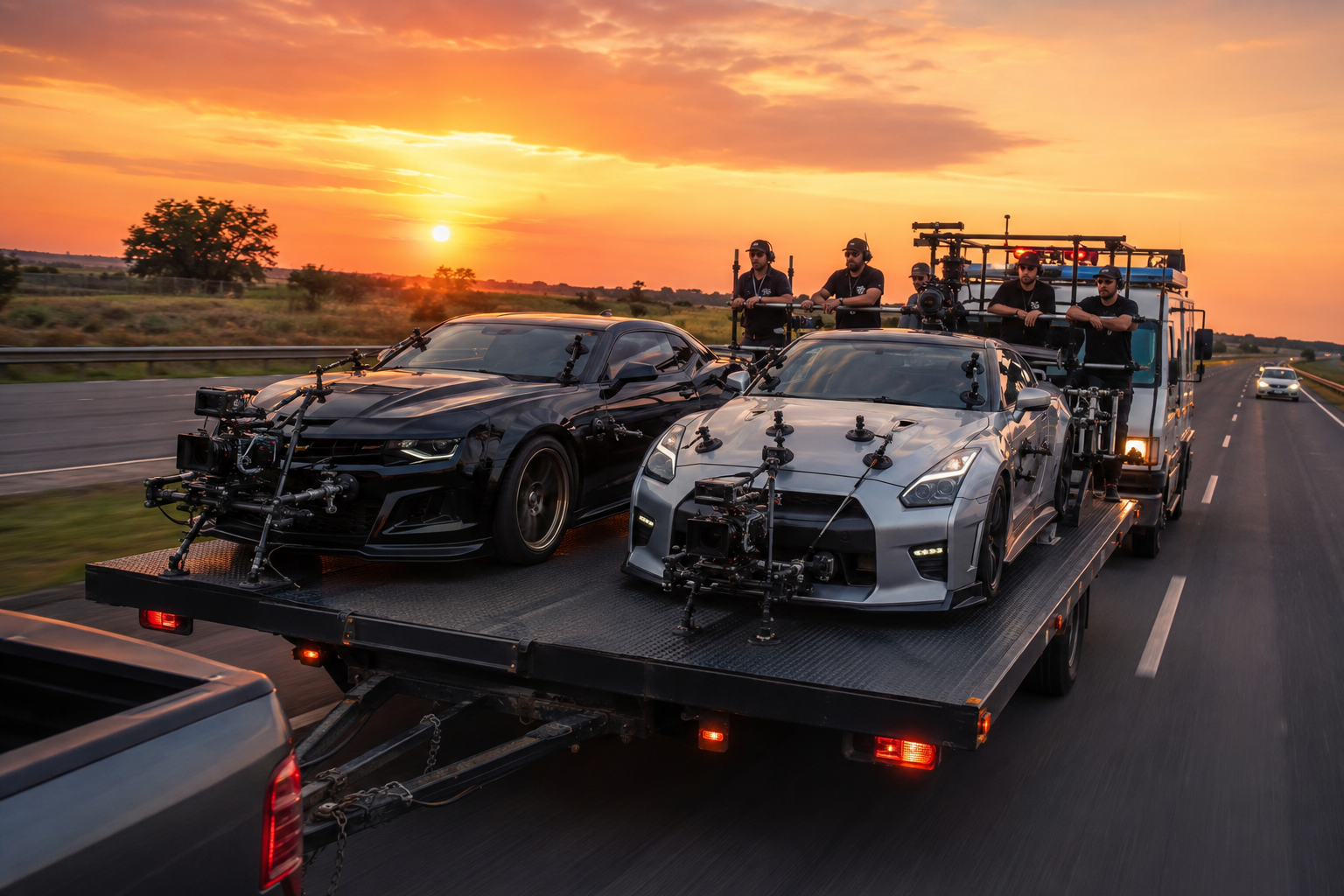
One of the oldest and most widely used techniques in filmmaking is the Process Trailer (or low-boy trailer).
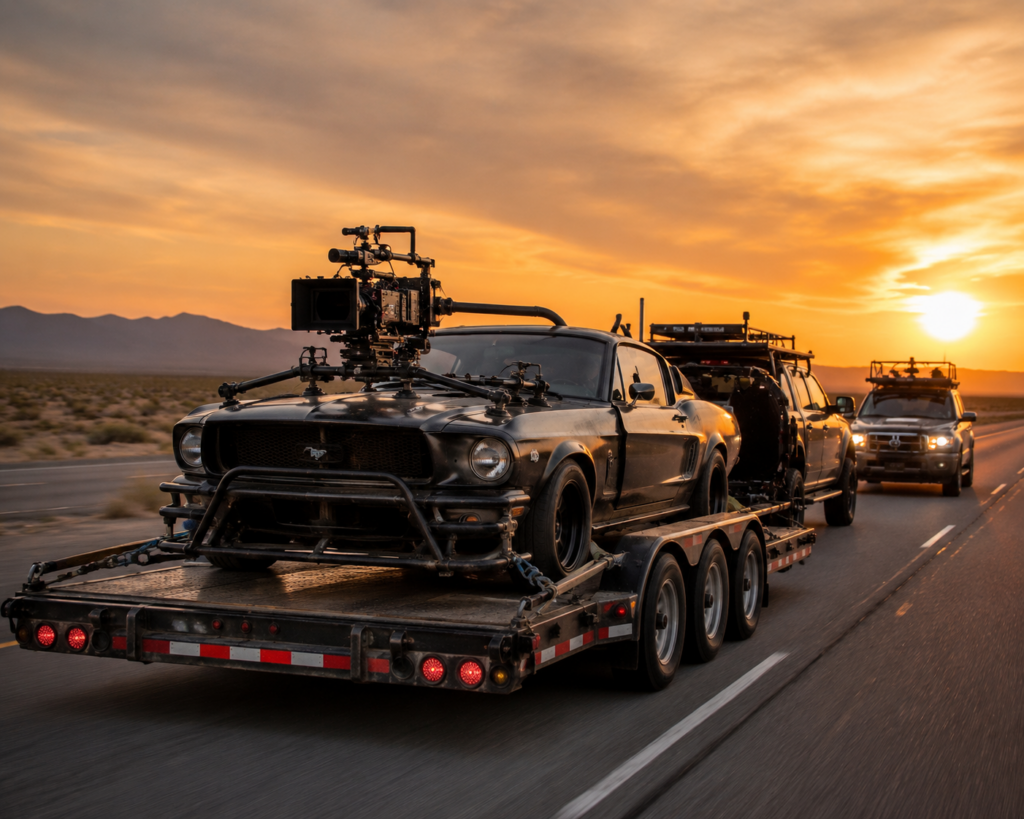
This is a specialized, low-profile flatbed trailer onto which the picture car—the vehicle seen on camera—is securely mounted and locked into place.
The trailer is towed down real roads by a heavy-duty technical truck equipped with power generators.
Audio and video monitoring stations, and seating for the director and camera crew.
Because the process trailer sits only a few inches above the asphalt.
It keeps the center of gravity low and closely mirrors the natural ride height of a car.
The actor sits in the driver’s seat handling a dummy steering wheel.
But full control over acceleration, braking, and steering rests entirely with the professional stunt driver operating the tow truck.
This setup allows camera operators to mount cinema equipment directly onto the trailer frame or attach it to the car’s body using specialized mounts.
As a result, the crew captures perfectly framed close-ups of the actors without demanding their attention on real-world traffic.
2. The Pod Car: Real Control with the Driver on the Roof
While a Process Trailer works exceptionally well on open highways,
It encounters limitations when a script demands aggressive driving, sharp turns, or narrow alley maneuvers.
To solve this challenge, special effects engineers developed a revolutionary alternative: the Pod Car.
A Pod Car is a modified vehicle where the mechanical and electronic controls for steering.
Throttle, and braking are extended outside the cabin to a reinforced steel cage (the “pod”) mounted on the roof or rear bumper.
-
Who drives the car? A professional stunt driver sits in the external pod above the roof, steering and controlling the vehicle with an unobstructed view of the road.
-
What does the actor do? Inside the main cabin, the actor operates a disconnected steering wheel, turning it freely to match the scene’s action.
-
What is the visual result? Cameras can be placed right in front of the actors or shoot through the windshield from any angle. Audiences see the car executing tight corners, knowing that actual control remains safely in the hands of an expert driver positioned out of frame.
3. Virtual Studios and LED Panels (The Volume LED Revolution)
In recent years, virtual production technology has fundamentally transformed how interior car scenes are filmed.
What previously required shutting down miles of public roadways can now be accomplished inside.
A soundstage using ultra-high-definition LED screens (a technology known as Volume LED or StageCraft).
In this setup, a real automobile is parked at the center of a stage surrounded by massive, curved LED walls covering the sides, rear, and ceiling of the space.
Why Is This Technology a Game-Changer?
Unlike traditional Green Screen (Chroma Key), LED walls display pre-recorded road footage in real time. The ultimate advantage of this technique lies in interactive photorealistic lighting:
-
Natural Reflections: Streetlights, passing headlights, trees, and buildings displayed on the screens naturally reflect across the car’s paintwork, windshield, and the actors’ eyes.
-
In-Camera Visual Effects: Camera tracking systems sync the perspective of the background render on the LED screen with the camera’s movement, creating convincing 3D depth in real time.
-
Total Environmental Control: Free from wind noise, weather changes, or traffic hazards, directors can shoot complex dialogue scenes repeatedly under identical lighting conditions.
4. Camera Rigs and Custom Mounts: Hood Mounts and Hostess Trays
When productions choose to shoot on location with moving vehicles, keeping cameras securely anchored to the car body without damaging the vehicle requires specialized rigging equipment.
The two most common mounting structures used on set include:
Hood Mounts
Hood mounts are heavy-duty aluminum tube rigs secured to the vehicle’s hood using industrial vacuum suction cups and safety steel straps.
They hold heavy cameras aimed directly through the front windshield, capturing two-shots of the driver and front passenger in a clean frame.
Hostess Trays
Hostess trays are horizontal metal plates mounted over the exterior door sill of a car window.
The camera rests outside the driver’s or passenger’s side window, providing profile shots of the actors as the car moves.
These setups are equipped with gyro-stabilized heads to eliminate unwanted road vibration.
5. Motion Simulation: The Physics of Static Car Acting
Even when a vehicle is stationary inside a studio under controlled lighting, the audience must believe that the car is actively driving down a real road.
To prevent scenes from looking flat or artificial, practical effects crews employ subtle physical motion techniques.
Hydraulic gimbals and pneumatic jacks are often installed beneath the vehicle’s frame to gently rock the chassis, mimicking engine rumble, gear changes, cornering lean, and road bumps.
Additionally, silent wind blowers direct controlled air currents through open windows to move the actors’ hair and clothing, reinforcing the sensation of momentum.
6. Specialized Vehicles: High-Speed Camera Cars and Robotic Arms
To capture high-velocity chase sequences from the outside, film productions deploy specialized Camera Cars.
These are high-performance sports cars or modified SUVs finished in matte black paint to eliminate glare and reflections.
Mounted on top of these chase vehicles is a remote-controlled, 360-degree rotating crane arm (often called a Russian Arm or Ultimate Arm).
This gyro-stabilized robotic arm allows a camera to hover inches off the asphalt.
Sweep over the roof of the actors’ car, and execute dynamic tracking shots at high speeds with complete safety and stability.
Conclusion
Recording memorable car scenes without placing actors in harm’s way is a testament to the safety-first engineering that defines modern filmmaking.
What appears on the silver screen as an everyday drive is, in reality,
A carefully choreographed symphony involving stunt drivers on roofs, towing flatbeds, virtual LED environments, and custom camera rigs.
Thanks to these technical innovations and the expertise of behind-the-scenes crews.
Filmmakers can deliver heart-pounding action and intimate conversations on the road while keeping actor safety at the forefront of every take.
Frequently Asked Questions (FAQ)
Do actors ever actually drive cars in movies?
On rare occasions under fully closed course conditions, yes.
However, in most scenes, actors only pretend to drive while the car is towed on a process trailer,
Steered by a stunt driver from a roof pod, or shot inside a virtual LED studio.
What is a Pod Car in filmmaking?
A Pod Car is a modified vehicle where driving controls (steering, gas, brakes) are relocated to a cage on the roof or rear.
A stunt driver operates the car from outside, while the actor inside handles a fake steering wheel for the camera.
Why are LED panels replacing green screens for car scenes?
LED panels (Volume LED) project realistic background footage in real time,
Creating natural reflections on the car’s body and glass while lighting the actors authentically, eliminating artificial green light spill.
How do film crews prevent reflections of the camera in car mirrors?
Interior and exterior side-view mirrors are often slightly angled away from the camera lens or digitally cleaned in post-production to prevent reflecting the camera operator and crew.