
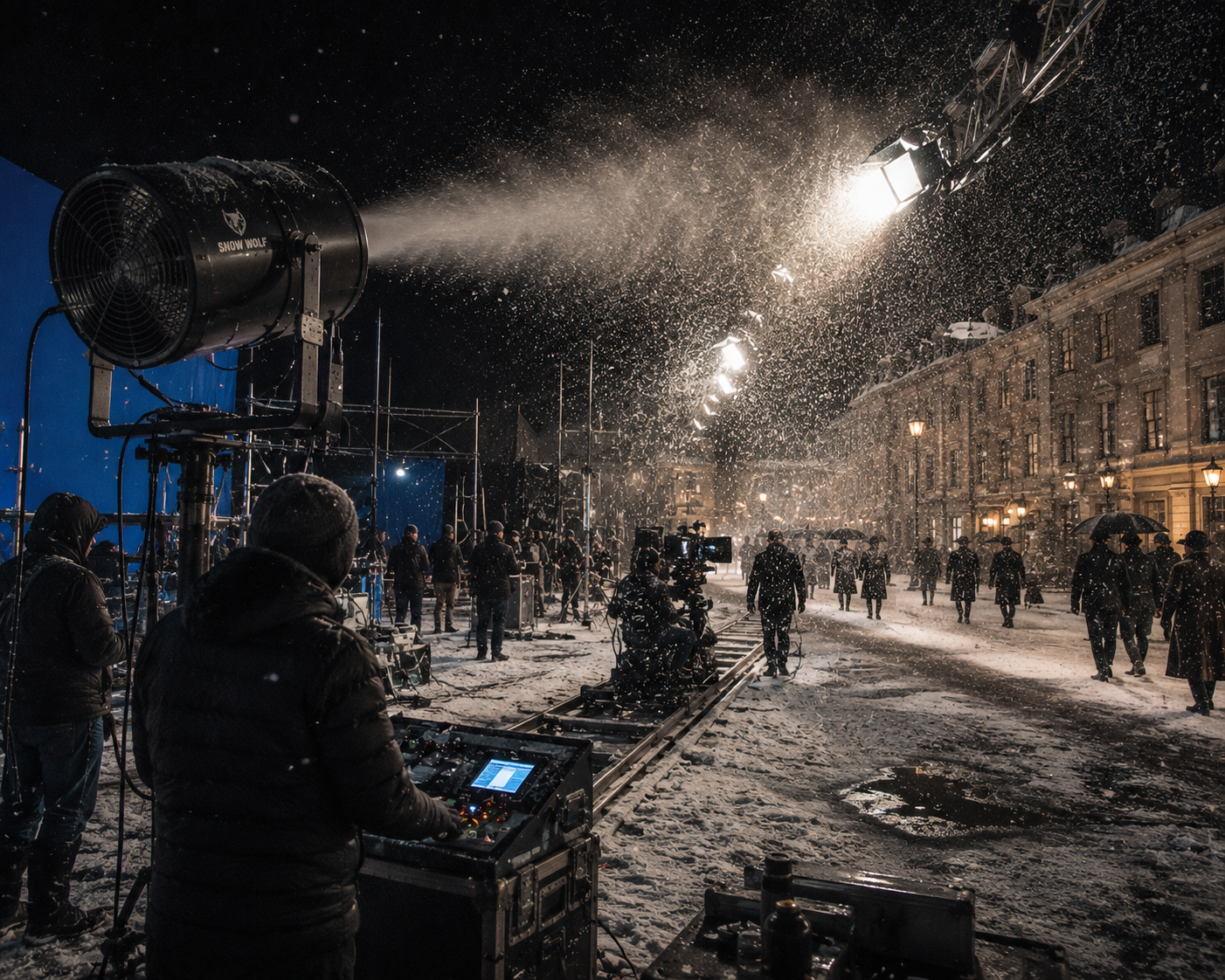
How Film Crews Control Artificial Weather on Movie Sets
When watching a devastating storm, a quiet snowfall, or dense fog in a movie.
Viewers rarely stop to consider the level of engineering required to create that moment.
In the film industry, weather is almost never left to chance.
Relying on actual meteorological weather to shoot a scene.
Is one of the single biggest financial and logistical risks a production team can take.
Real rain can stop in the middle of a crucial dialogue.
The sun can suddenly break through during a gloomy scene.
Or snow can melt before the director even finishes rolling the first take.
To guarantee absolute visual continuity, crew safety, and creative control, the film industry has developed remarkably sophisticated techniques for controlling artificial weather.
Led by Practical Special Effects (SFX) teams, these operations combine physics, hydraulics, chemistry, and specialized lighting to simulate virtually any natural phenomenon on demand. Below, we step behind the scenes to reveal the technological secrets of how climate is manufactured on modern film sets.
The Magic of Controlled Climate: Why Real Weather Fails in Cinema
The primary reason for manufacturing artificial weather in movies comes down to one word: continuity. A three-minute action sequence on screen can take days or even weeks to film. If the crew relied on real weather, the light quality, rain intensity, or fog density would shift constantly between takes, turning the final edit into a visual disaster.
Beyond visual continuity, several crucial factors justify the investment in scenic climate control:
-
Cost of downtime: A large-scale film set sitting idle while waiting for the “perfect” storm can cost tens of thousands of dollars per hour.
-
Crew and cast safety: Real storms bring unacceptable hazards, such as lightning strikes, unpredictable wind gusts, and flash flooding.
-
Equipment protection: High-end cinema cameras, lenses, and audio gear require planned protection against moisture and dust, which is impossible during unpredictable wild weather.
Cinematic Rain: Rigs, Pressure, and the Secret Backlight
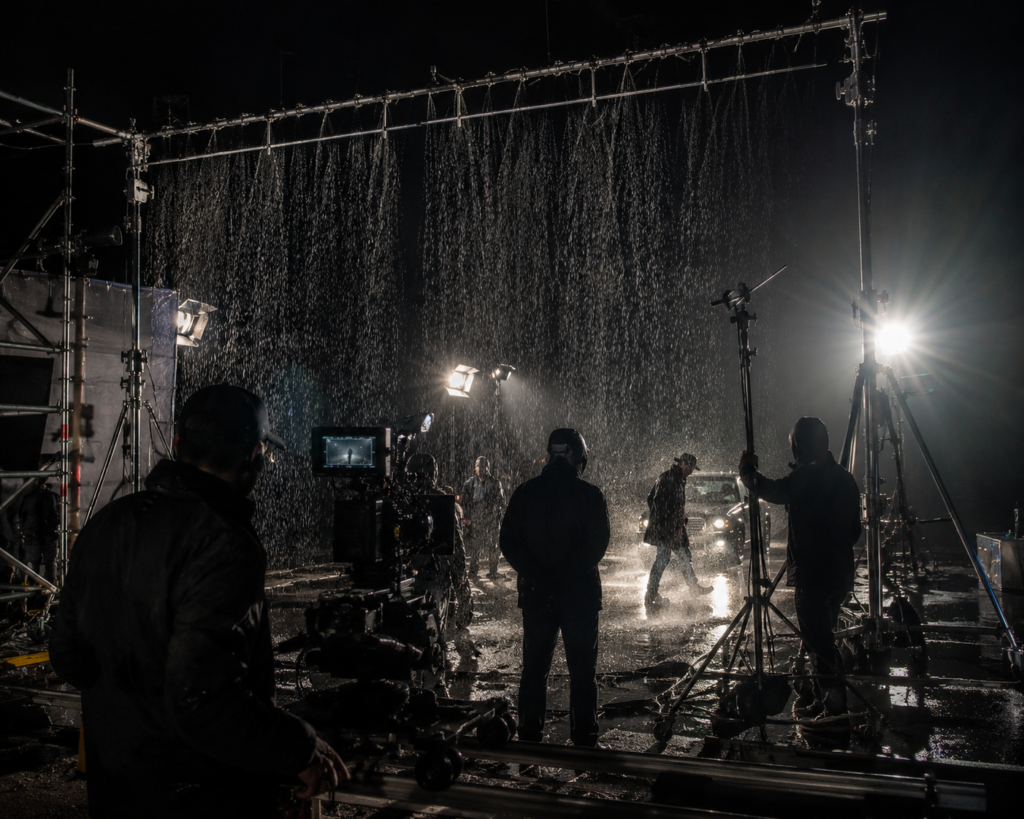
Creating rain on a movie set might seem straightforward—just spray water into the air, right? In practice, real rainwater drops are virtually invisible to high-speed cinema camera lenses. Natural raindrops are too small and fall at a velocity that cameras cannot capture clearly without proper setup.
To solve this, SFX crews use custom rain bars and manifolds mounted on massive cranes known as condors. These systems utilize pressurized nozzles that produce water droplets significantly larger than natural rain, ensuring they catch the light and register on camera.
       [ Crane / Condor Rig ]
                  │
          ┌───────┴───────┐
          │   Rain Bar    │  (Adjustable water pressure)
          └───────┬───────┘
                  │  💧  💧  💧  (Larger scenic droplets)
                  ▼
       [ Backlight Rig ]  ──►  [ Camera ]
The Secret of Backlighting
Water is translucent. Without a strong light source coming from behind the drops (backlight or rim light), artificial rain completely disappears against dark backgrounds. The Director of Photography places high-powered spotlights behind the falling water so that each droplet refracts light, making the downpour pop on screen.
Water Heating and Drainage Systems
To prevent actors from suffering hypothermia during grueling multi-take night shoots, the water supplied to rain bars is routed through industrial water heaters. Furthermore, catchment basins, sump pumps, and underground drainage channels are installed around the set to recycle the water and prevent the studio from flooding.
Artificial Snow: From Toxic Dust to Biodegradable Polymers
Cinematic snow has a dark history—in the 1930s and 1940s.
Productions dangerously used white asbestos fibers to simulate falling flakes. Fortunately, modern technology has evolved toward completely safe, eco-friendly solutions.
Today, movie snow is divided into two primary operational categories: falling snow and accumulated ground snow.
| Snow Type | Material Used | Primary Application |
| Falling Snow (Floating) | Soap-based foam and neutral polymers | Ideal for dialogue scenes, as it falls quietly and dissipates on impact without making noise. |
| Ground Snow (Accumulated) | Shredded recycled paper (cellulose) | Blown with industrial blowers to blanket wide areas of forest, roads, and rooftops. |
| Frost and Ice Effects | Paraffin wax, salt, and clear resins | Applied to windows, vehicles, and costumes to mimic sudden freezing conditions. |
In modern productions, superabsorbent polymers (similar to those found in baby diapers) mixed with water create a realistic gelatinous slush for close-up shots that will not melt under hot studio lights.
Storms and Wind Gusts: High-Powered Turbines and Blowers
Wind provides the chaotic energy necessary to make any weather scene believable. In classic Hollywood, film crews used actual airplane engines with exposed propellers—a method that was notoriously deafening and dangerous. Today, SFX departments rely on whisper-quiet electric wind machines and high-output industrial blowers known as Ritchey Fans.
These giant fans are equipped with variable frequency drives, allowing technicians to adjust air speed from a gentle breeze to hurricane-force gusts at the turn of a dial.
To enhance realism, crews inject scenic debris directly into the airstream, including:
-
Artificial leaves: Made from biodegradable paper that decomposes naturally outdoors.
-
Scenic dust and dirt: Produced from finely ground walnut shells or inert organic materials to prevent respiratory irritation for the cast.
-
Water mist sprayers: Blended into high-speed air streams to simulate ocean spray or gale-force rainstorms.
Fog, Mist, and Haze: The Physics of Cinematic Atmosphere
Fog in movies does more than just signal cold or spooky weather.
It serves as a critical tool for establishing visual depth.
By filling the air with a delicate atmospheric haze, background objects lose contrast, creating three-dimensional separation between the actors and their environment.
Special effects teams utilize three primary machine types to manipulate atmospheric density:
-
Hazers (Atmospheric Haze Generators): Produce an ultra-fine, nearly invisible mist that catches light beams, rendering light rays from lamps and sunbeams visible (Tyndall effect).
-
Foggers (Dense Smoke Generators): Vaporize glycol- or vegetable glycerin-based fluids mixed with distilled water to generate thick, rolling clouds of smoke.
-
Dry Ice (Solid Carbon Dioxide): Used to produce “low-lying fog.” Because cold CO₂ is denser than ambient air, the fog hugs the ground, creating a classic look for haunted forests or fantasy scenes.
Storm Lighting: Simulating Lightning Flashes and Color Temperatures
Artificial weather only becomes convincing when the lighting team—led by the Director of Photography and the Gaffer—works in synchronized harmony with the practical effects crew.
To simulate lightning strikes, traditional strobe lighting has been largely replaced by computer-controlled LED light panels. These fixtures can be pre-programmed with custom flash patterns that accurately replicate the unpredictable intensity, flicker, and duration of real lightning.
Additionally, color temperature plays a major psychological role in guiding the audience’s perception:
-
Cool Tones (Blue / 5600K to 7000K): Used to convey cold rainy nights, blizzard conditions, and freezing environments.
-
Warm Tones (Orange / 2800K to 3200K): Applied during extreme heatwaves, droughts, or desert sandstorms.
Conclusion
Controlling artificial weather on movie sets is a masterclass in combining scientific precision, strict safety protocols, and artistic storytelling. What appears on screen as an unstoppable force of nature is, in reality, the product of months of careful planning, complex hydraulic rigs, fluid chemistry, and expert lighting design.
The next time you watch an actor brave a howling blizzard or a torrential downpour in a movie, remember that every single drop of water and flake of snow was engineered to create the perfect cinematic illusion.
Frequently Asked Questions (FAQ)
Is the water used in artificial rain scenes recycled?
Yes. Modern film productions install catchment trays and filtration systems on set to collect falling water, filter out debris, and pump it back into storage tanks, minimizing water waste during long shoots.
How do sound crews record actors’ dialogue during an artificial storm?
Because water rigs and wind blowers are loud, sound crews use waterproof mic covers and high-wind protection (deadcats). In many cases, clean dialogue audio is recorded or replaced later in a studio environment using Automated Dialogue Replacement (ADR).
Is artificial snow used in movies harmful to health or the environment?
No. Modern cinematic snow materials are non-toxic, biodegradable, and water-soluble, typically made from recycled cellulose or neutral polymers. Toxic materials like asbestos were banned from movie sets decades ago.
How do film crews create dust for desert sandstorms?
To protect actors and crew from inhaling real sand dust containing silica, crews use safe organic substitutes like finely milled walnut shells, expanded cornstarch, or inert organic pigments.