
Practical Effects in Movies: How They Are Made Behind the Scenes
When we watch a movie and encounter a terrifyingly realistic monster, a colossal highway explosion, or a fantastical creature seamlessly interacting with the cast, we rarely stop to consider the intricate craftsmanship behind that single moment. In an era dominated by computer graphics and green screens, practical effects—those created physically in front of the camera lens during filming—remain the vital backbone of cinematic realism.
Unlike Computer-Generated Imagery (CGI), which is constructed digitally during post-production, practical effects happen in the physical world. They demand an extraordinary synthesis of sculpting, physics, chemistry, robotics, and mechanical engineering. This tactile reality creates an irreplaceable atmosphere on set, allowing natural light to bounce authentically off surfaces and giving actors genuine physical elements to react to instead of green tracking dots on a bare wall.
In this deep dive behind the scenes of major motion pictures, we will uncover the secrets, techniques, and processes used by practical special effects masters to bring the impossible to life.
1. What Are Practical Effects and How Do They Differ from CGI?
To understand how movie magic is made behind the scenes, it is essential to distinguish between two terms that are often confused: practical special effects (SFX) and visual effects (VFX). Practical effects refer to any physical illusion created live on set or location during principal photography. This encompasses everything from a simple bead of artificial sweat running down an actor’s forehead to flipping a full-sized truck on an open road.
Visual effects (VFX), on the other hand, involve manipulating or generating imagery using computer software in post-production. While CGI has undeniably revolutionized filmmaking by enabling impossible camera angles and sprawling fantasy worlds, it can sometimes lack physical weight, organic texture, and natural interaction with environmental lighting.
Practical effects provide that exact physical tangibility. When a real wall shatters on camera, the dust particles floating through the air and the heavy debris crashing to the floor obey the exact laws of gravity while reflecting studio lights in a completely organic way.
2. Prosthetic Makeup and Animatronics: Bringing Realistic Creatures to Life
One of the most fascinating domains within practical effects is the creation of hyper-realistic monsters, alien beings, and believable injuries using custom prosthetic makeup and mechatronic robotics.
The Art of Sculpting and Silicone Molding
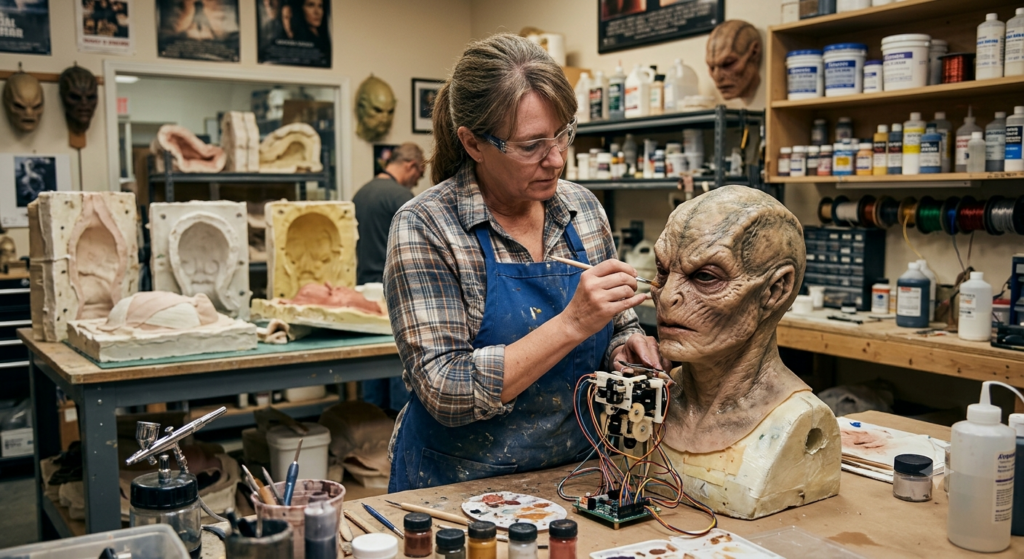
The process of bringing a creature or physical transformation to life begins long before the camera rolls. First, effects artists create a precise plaster cast of the actor’s body or head—a process known as lifecasting. Working directly on this plaster mold, a master sculptor shapes the detailed features of the monster or wound using specialized clay.
Once the design is finalized, the clay sculpture is used to produce a negative mold into which flexible materials like medical-grade silicone or foam latex are poured. After curing, these prosthetic appliances are glued to the actor’s skin and hand-painted with airbrushes to blend seamlessly with human skin tones, concealing any visible seams.
Mechatronics and Animatronics on Set
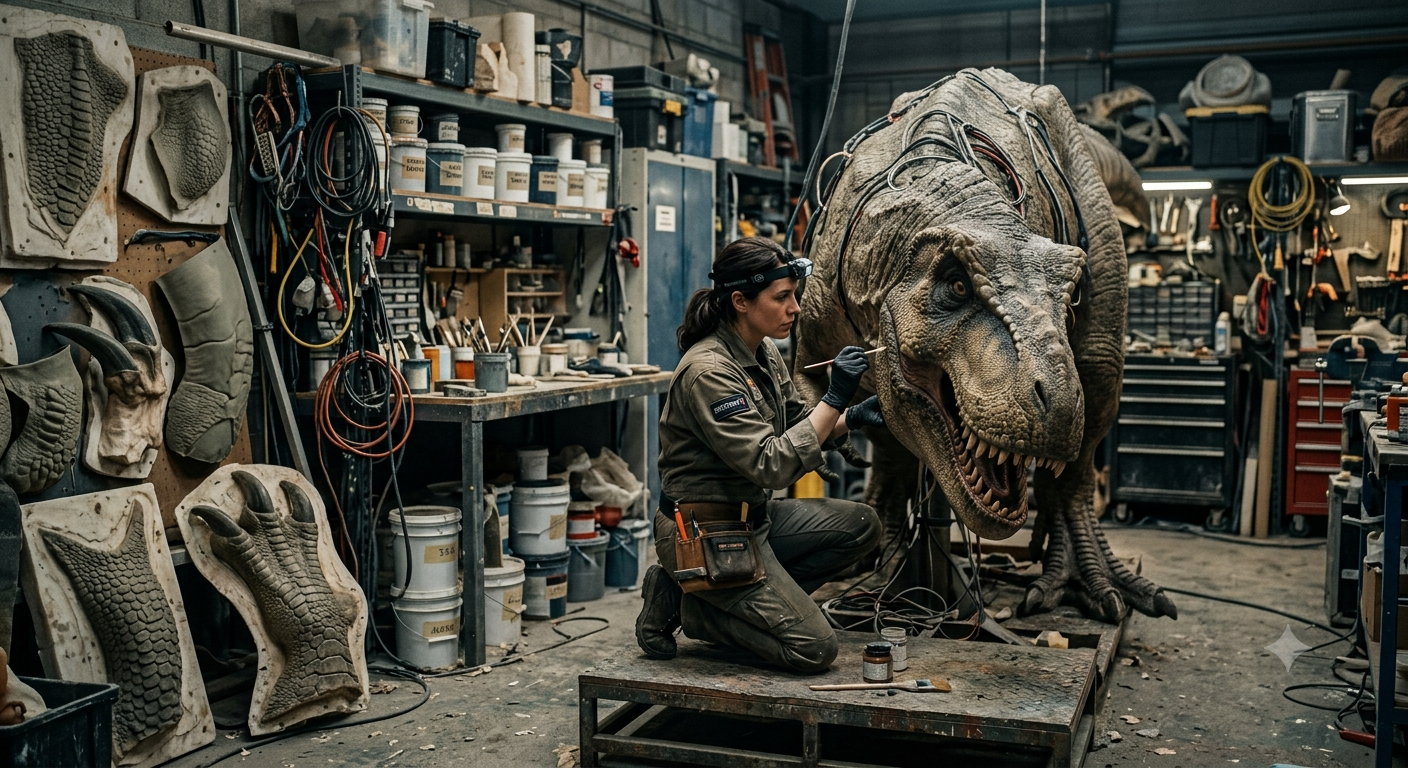
When a scene calls for an oversized creature or superhuman facial expressions beyond human anatomy, animatronics take center stage. Animatronics are robotic skeletons encased in hyper-realistic silicone skin. Internally, these mechanical puppets contain micro-servos, tension cables, and pneumatic pistons.
Behind the camera, a team of puppeteers controls the creature’s movements remotely using radio controllers. One operator might govern eye blinks, another manages brow movement, while a third operates jaw articulation. The result is a robotic organism capable of expressing subtle emotions and interacting with the cast in real time.
3. Pyrotechnics and Controlled Explosions: The Physics of Real Action
War scenes, intense shootouts, and fiery explosions require extreme technical precision and rigorous safety protocols. Film pyrotechnicians are licensed experts in chemical compounds and applied dynamics.
-
Squibs (Blood Charges): To simulate the realistic impact of gunshots on a character, pyrotechnicians use squibs—tiny, low-grade explosive detonators placed beneath an actor’s wardrobe. These are paired with a sealed pouch of fake blood and a metal backing plate to protect the performer. When triggered remotely, the squib rips through fabric and sprays blood at the exact required millisecond.
-
Air Mortars: To generate dramatic explosions with flying dust and debris near actors without endangering the crew, technicians rely on high-pressure air mortars. Compressed air is instantly released from steel tanks, blasting peat moss, cork, and balsa wood into the air to simulate a bomb blast without actual fire.
-
Cinematic Fire and Stunt Gels: When real fire is required, special fuel mixtures and fire-retardant gels are applied directly to stunt performers’ skin and clothing, allowing them to safely remain engulfed in flames for controlled periods.
4. Miniatures, Scale Models, and the Magic of Forced Perspective
Before the advent of digital 3D modeling, sprawling environments such as medieval castles, futuristic cityscapes, or massive starships were constructed as physical scale models, often referred to as miniatures or “bigatures.”
To make a three-meter-tall model look like an eighty-story skyscraper on screen, cinematographers rely on clever camera trickery:
-
High-Speed Photography: When a miniature ship sinks in a water tank, water droplets naturally move too quickly for a full-scale vessel. By filming the miniature at high frame rates (super slow-motion playback), the movement of water and debris slows down, conveying immense physical weight and scale.
-
Forced Perspective: By placing a small physical model close to the camera lens while positioning the actor far in the background at a calculated distance, the optical illusion tricks the eye into perceiving the near object as a towering structure relative to the person.
5. Rigging and Gimbals: The Engineering of Action and Motion
Simulating out-of-control vehicles, aircraft caught in turbulence, or entire rooms rotating 360 degrees requires heavy mechanical structures known as hydraulic gimbals.
Gimbals are customizable, multi-axis hydraulic platforms capable of tilting, shaking, and rotating tons of set construction built directly on top of them. If a script calls for the interior of a crashing airplane, the entire cabin set is mounted onto a massive gimbal system, forcing actors and props to react authentically to simulated gravitational forces.
Furthermore, technical rigging crews utilize intricate systems of steel cables and winches to hoist stunt performers. This allows for impossible jumps, wire-assisted flight, or controlled falls. During post-production, these thin steel wires are digitally erased, leaving behind pure physical action on screen.
6. The Perfect Alliance: The Hybrid Approach Between Practical Effects and CGI
It is a common misconception that modern filmmakers must choose strictly between practical effects and computer graphics. In truth, today’s most visually stunning blockbuster productions employ a refined hybrid approach.
Directors use practical effects to capture the crucial groundwork—authentic lighting bouncing off a silicone monster’s skin, the real momentum of a vehicle crash, or genuine dust clouds filling a room. Post-production visual effects teams then step in digitally to refine and elevate what was captured on camera: painting out wire rigs, erasing safety harnesses, cleaning up background elements, or adding atmospheric smoke and embers.
This hybrid workflow delivers the best of both worlds: the physical credibility of real materials combined with the creative freedom of digital technology.
7. Frequently Asked Questions (FAQ)
What is the primary difference between practical effects and visual effects?
Practical effects (SFX) are created physically on set during live-action filming, such as real explosions, animatronic puppets, and prosthetic makeup. Visual effects (VFX) are generated or altered digitally on computers during post-production.
What is fake movie blood made of behind the scenes?
The classic fake blood recipe uses corn syrup as a base for viscosity, red, blue, and yellow food coloring for accurate crimson tones, and a small amount of liquid soap to allow easy cleaning from skin and wardrobe.
Is the glass broken in movie action scenes real glass?
No. To prevent injuries to actors and stunt performers, productions use “sugar glass” (made from sugar and water) or breakaway glass made from lightweight plastic resins or synthetic silicone.
Why do many directors still prefer practical effects over CGI?
Filmmakers prefer practical effects because they interact naturally with set lighting, provide actors with tangible elements to react to, and age remarkably well over time, keeping the film visually convincing for decades.
8. Conclusion: The Invaluable Worth of Tangibility in Cinema
The creation of practical effects behind the scenes of cinema is a celebration of human ingenuity and artistic passion. It seamlessly unites the artistic sensibilities of sculptors and painters with the scientific precision of mechanical engineers and pyrotechnicians.
Even in a digital age where artificial intelligence and computer graphics advance rapidly, the weight of physical matter and the human touch remain irreplaceable. Practical effects anchor extraordinary stories in tangible reality, reminding audiences that behind every mesmerizing frame lies a dedicated team working tirelessly to transform the impossible into something we can see, feel, and believe.