
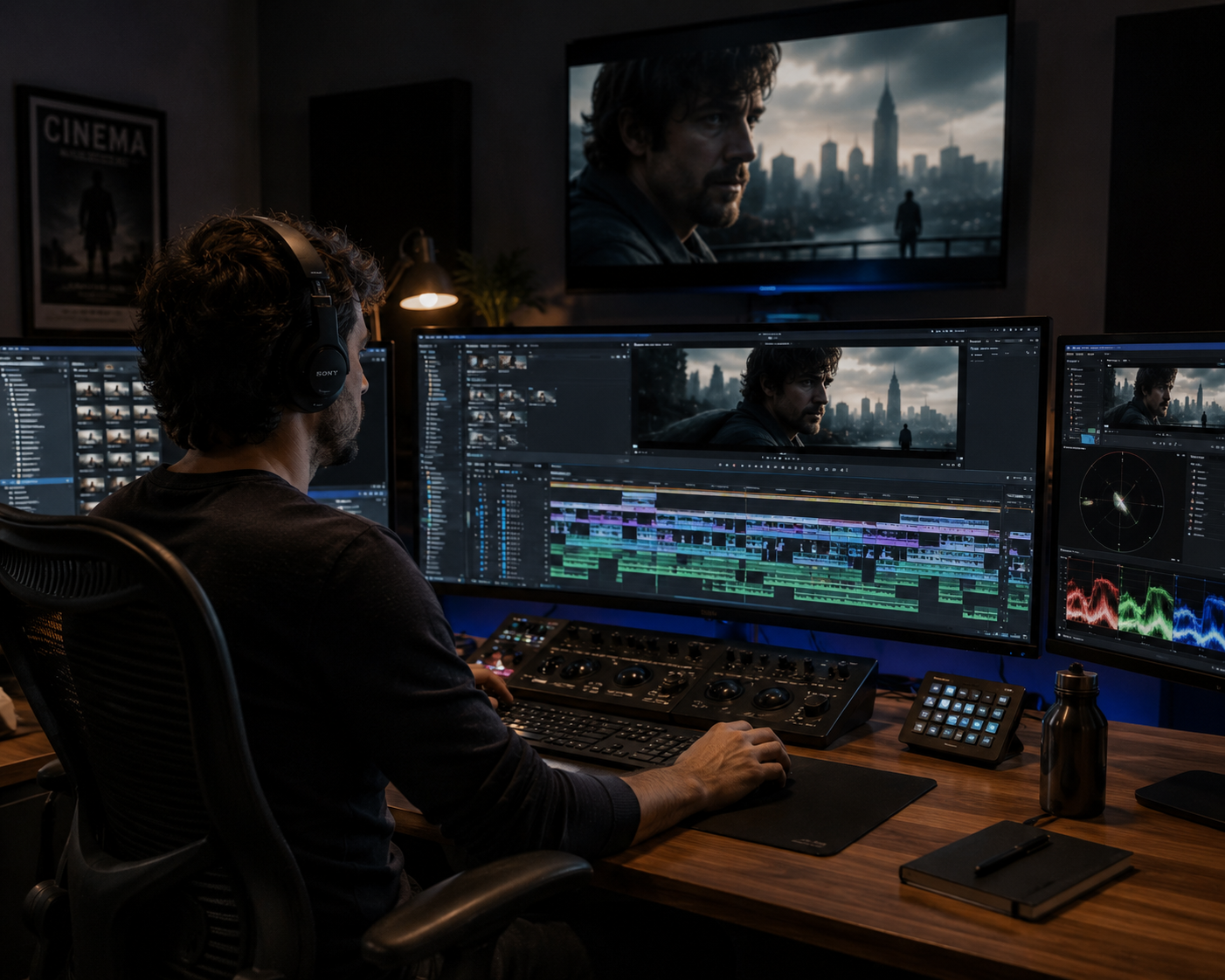
The Editing Secrets That Completely Change a Movie
Alfred Hitchcock famously observed that a film is created three distinct times: first when writing the screenplay, second on set during principal photography, and finally in the editing suite when assembling the captured footage. While shooting provides the raw building blocks, it is the edit—or montage—that breathes rhythm, tone, and emotional soul into the visual narrative. Editing is frequently celebrated as the “invisible art” of cinema because when executed flawlessly, the viewer never notices its existence. Yet, a single cut holds the power to transform a lighthearted comedy into a gripping thriller or rescue a troubled production destined for failure.
Editing extends far beyond trimming errors or stitching shots in chronological order. It is a psychological and narrative discipline capable of manipulating time, redirecting audience empathy, and recontextualizing actor performances. In this article, we step behind the scenes to uncover the core secrets of film editing, exploring how the seamless merging of images and sound creates the true magic of cinema.
The Invisible Art: Why Editing Is the Ultimate Rewrite
When a director wraps principal photography, the physical heavy lifting of production is complete, but the true assembly of the story has only just begun. The film editor receives hundreds of hours of raw footage captured from various angles, lenses, and lighting setups. Their fundamental mission is to comb through these takes, select the most effective frames, and weave them into a coherent whole.
It is inside the editing bay that the screenplay’s structure undergoes its most demanding test. Entire sequences that felt brilliant on paper might be discarded because they drag down the narrative momentum. Conversely, lines of dialogue can be rearranged or paired with subtle reaction shots to craft chemistry between characters that did not exist on set. The editor operates as both the film’s first objective viewer and a crucial co-author responsible for delivering the final version of the story.
The Kuleshov Effect: How Image Order Shapes Meaning
One of the most famous experiments in cinema history highlights the profound psychological impact of editing. In the 1920s, Soviet filmmaker Lev Kuleshov conducted a study in which he juxtaposed the exact same neutral shot of actor Ivan Mosjoukine’s face with three distinct images: a bowl of soup, a child in a coffin, and a woman lying on a couch.
Audiences praised the actor’s subtle versatility, sensing deep hunger in the first combination, overwhelming grief in the second, and desire in the third. Yet, Mosjoukine’s facial expression remained completely identical in every instance. The Kuleshov Effect proved that the human brain constructs meaning not from a single isolated shot, but from the contextual relationship between two images placed in sequence. By altering the order of cuts, an editor can inject emotion, subtext, and intent that were never explicitly acted on camera.
Pacing and Dramatic Timing: Controlling Tension and Adrenaline
The emotional heartbeat of any movie is dictated by the frequency and duration of edits on the timeline. Action sequences leverage rapid, successive cuts to induce sensory overload, urgency, and an elevated heart rate in the audience. In contrast, slow-burning dramas and suspense thrillers rely on long, uninterrupted takes and sparse cuts, allowing tension, silence, and discomfort to linger across the frame.
Manipulating dramatic timing allows filmmakers to stretch or compress reality at will. A real-world event lasting only five seconds can be expanded across several minutes through repetitive cuts from multiple camera angles. Similarly, several decades in a protagonist’s life can be synthesized into a sleek 30-second montage. Mastering this temporal geometry ensures that the audience remains captivated from opening frame to final credits.
Hard Cuts, J-Cuts, and L-Cuts: Essential Transition Techniques
To build smooth, seamless transitions that keep the audience immersed, editors rely on fundamental relationships between audio and video tracks:
-
Hard Cut: The most straightforward transition, cutting cleanly from one shot directly to another. It maintains immediate momentum and keeps dialogue moving forward naturally.
-
J-Cut: An audio transition where the sound of the upcoming scene leads and is heard before the video cuts to the new shot. This prepares the viewer’s brain for the spatial shift, making atmospheric changes feel natural.
-
L-Cut: The video cuts away to a new shot while the audio from the previous scene continues playing for a few extra moments. This technique is ideal for highlighting emotional reaction shots while an off-screen character finishes speaking.
-
Match Cut: A visual or auditory cut that connects two entirely different scenes through matching shapes, movements, or sounds, establishing striking visual poetry and thematic connections.
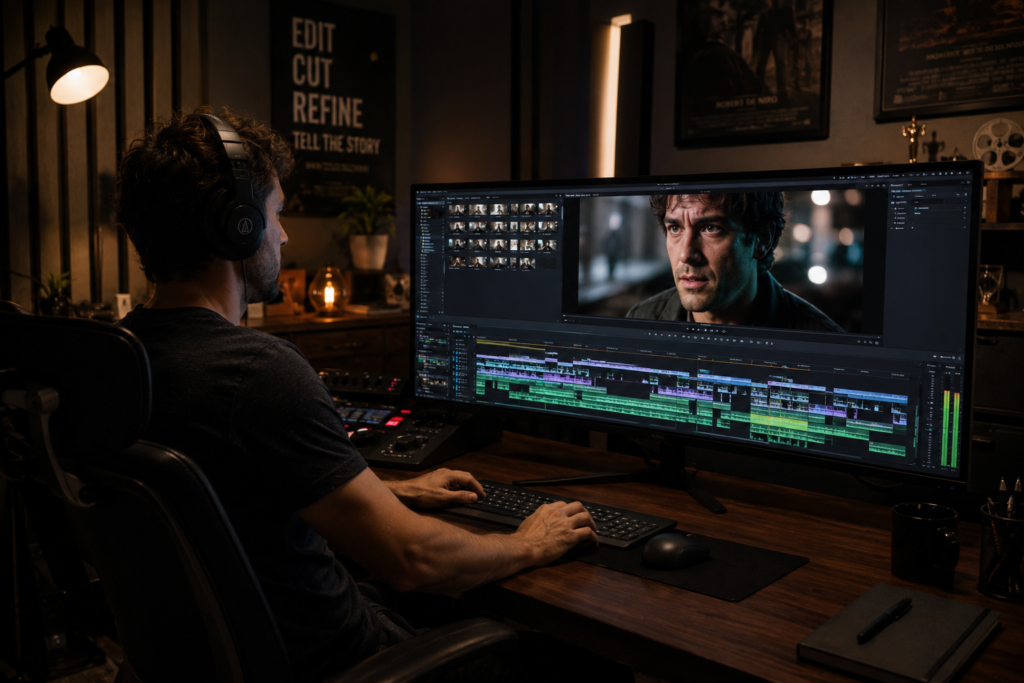
Parallel Editing: Building Intersecting Climaxes
Parallel editing (or cross-cutting) is one of the most powerful storytelling mechanics used to elevate dramatic tension. It involves cutting back and forth between two or more narrative threads occurring simultaneously in different physical locations.
Consider a classic heist or rescue sequence: the edit alternates between a protagonist racing against the clock and a ticking explosive device counting down, or between intruders inside a vault and law enforcement speeding toward the building. By weaving these parallel lines together, the editor builds a feeling of inevitable convergence that heightens audience anxiety. Parallel editing is also frequently used to highlight thematic contrasts or draw emotional parallels between characters miles apart.
Rescuing Masterpieces in the Edit Suite
Cinematic history is filled with iconic masterpieces that survived chaotic shoots and were completely reshaped during post-production editing:
-
Star Wars: A New Hope (1977): The original rough cut suffered from sluggish pacing and unfocused storytelling. Lead editor Marcia Lucas, working alongside Paul Hirsch and Richard Chew, completely restructured the climactic Death Star battle. They added the ticking-clock countdown to the destruction of the rebel base—an element barely present in the script—giving the climax the pulse-pounding urgency that made cinematic history.
-
Jaws (1975): Severe mechanical failures with the animatronic shark forced director Steven Spielberg and editor Verna Fields to reduce direct sightings of the monster. By withholding visual reveals and cutting around suspenseful reaction shots and John Williams’ haunting score, the edit transformed a potentially campy monster movie into a masterclass in psychological terror.
-
Apocalypse Now (1979): Faced with hundreds of hours of chaotic jungle footage, editor Walter Murch spent nearly two years sifting through material, structuring sound design, and building narrative coherence for Francis Ford Coppola’s legendary Vietnam War epic.
Continuity Editing vs. Discontinuous Editing
Filmmakers generally follow one of two overarching philosophical approaches to editing: continuity editing or discontinuous editing.
Continuity editing represents the classic Hollywood style. Its primary objective is to maintain spatial logic, temporal flow, and seamless narrative progression (adhering strictly to rules like the 180-degree rule and cutting on action). The ultimate goal is to make the editing invisible, allowing the viewer to focus entirely on story and character.
Conversely, discontinuous editing deliberately shatters these traditional conventions. Pioneered by French New Wave filmmakers and Soviet montage theorists, this style uses jarring jump cuts, broken camera axes, and repeated takes to disorient the audience, provoke intellectual reflection, or project psychological instability on screen.
Practical Editing Advice for Independent Filmmakers
Whether you are working on an indie feature or creating digital video content, applying professional editing principles elevates the quality of your final cut:
-
Edit Driven by Audio: Allow the rhythm of the music track, ambient soundscapes, and vocal pauses to determine where video cuts occur naturally.
-
Cut on Action: Execute cuts during moments of physical motion—such as a character turning their head, opening a door, or throwing a punch. Movement hides the cut from the viewer’s eye.
-
Emphasize Reaction Shots: Often, the emotional impact of a scene lives in the silent expression of the listener rather than the person speaking the line.
-
Be Ruthless in Trimming: If a shot or line does not advance the plot, deepen characterization, or serve a clear emotional purpose, cut it without hesitation.
Conclusion
Editing is the foundational language of cinema—the precise stage where fragmented pieces of picture and sound merge into a living, breathing narrative experience. Far from being a mere technical cleanup task, editing is the art of shaping time and guiding human emotion. By understanding the hidden mechanics operating inside the editing suite, we gain a deeper appreciation for the craft of filmmaking, discovering that the true power of cinema often resides in the quiet space between one cut and the next.
Frequently Asked Questions (FAQ)
What is the primary role of a film editor?
A film editor selects, arranges, and cuts recorded takes into a cohesive final movie. They control story pacing, align sound with picture, craft scene transitions, and maintain the film’s emotional tone and structural continuity.
What is the Kuleshov Effect and why does it matter?
The Kuleshov Effect is a psychological phenomenon showing that viewers derive context and emotion from the interaction of two sequential shots rather than a single shot in isolation. It proves that editing creates meaning through association rather than isolated images alone.
What is the difference between a J-Cut and an L-Cut?
In a J-Cut, the audio from the next shot begins playing before the video switches. In an L-Cut, the video changes to the next shot while the previous scene’s audio lingers briefly. Both techniques help smooth out visual cuts for the viewer.
Can editing completely change the tone or genre of a film?
Yes. Editing can alter scene order, narrative pacing, actor performance emphasis, and sound design. Strategic changes in the edit suite can turn a drama into a thriller or fix major story flaws present in the original script.