
How Underwater Scenes Are Filmed in Movies and TV Shows
Watching a movie character dive into the deep ocean, explore submerged ancient ruins, or engage in a high-stakes aquatic battle is a mesmerizing experience. Blockbusters like Avatar: The Way of Water, Titanic, The Shape of Water, Black Panther: Wakanda Forever, and Aquaman have captivated audiences by bringing vibrant, breathtaking underwater worlds to life on screen.
Yet, what appears graceful, weightless, and poetic in the final cut is widely recognized by filmmakers as one of the most grueling logistical nightmares in cinema. Water is unpredictable, inherently destructive to electronic equipment, alters the physics of light, and imposes strict physiological limits on human endurance and safety.
To conquer these physical obstacles and deliver unforgettable cinematic moments, the film industry relies on an extraordinary blend of engineering, intense physical conditioning, state-of-the-art visual effects, and clever optical illusions. In this deep dive behind the scenes, you will discover the exact techniques and technologies used to film underwater scenes in modern movies and television shows.
The Physics and Optical Challenges of Shooting Underwater
Filming beneath the surface involves far more than simply placing a standard camera inside a waterproof plastic pouch. Water fundamentally changes how light, color, and sound behave, presenting unique optical hurdles for directors of photography.
The first major obstacle is refraction and magnification. Water acts as a natural magnifying lens, expanding objects by roughly 33% and making them appear visually closer than they actually are, which distorts focal depth. Furthermore, as depth increases, a phenomenon known as color absorption occurs: warm wavelengths of light (such as reds, oranges, and yellows) are absorbed within the first few meters of water. Without powerful artificial lighting, underwater scenes naturally wash out into a monochromatic, murky blue-green tint.
Water density and floating particulate matter also create persistent clarity issues. Microscopic debris, dust, or air bubbles disperse light and blur the image, requiring filming environments to maintain continuous water filtration systems to preserve crystalline transparency on camera.
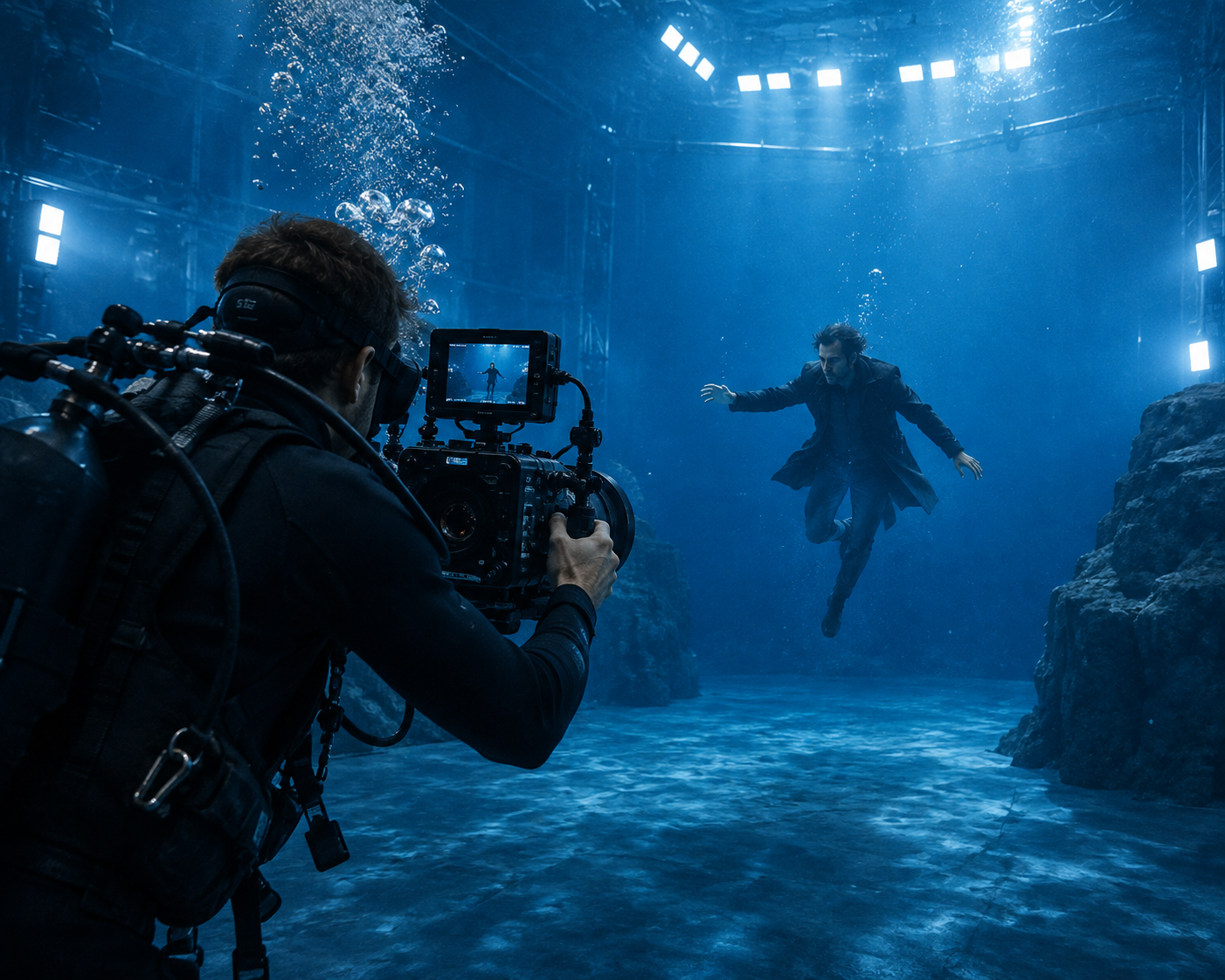
Massive Water Tanks and Dedicated Aquatic Soundstages
While shooting on location in open oceans or natural lakes might sound ideal for realism, it is notoriously risky and expensive. Ocean tides, unpredictable weather, dangerous marine life, shifting sunlight, and strong currents make outdoor water shoots nearly impossible to control.
Because of these variables, the vast majority of aquatic scenes are filmed in controlled indoor water tanks built inside specialized soundstages. World-renowned facilities, such as Pinewood Studios in the UK and Leavesden Studios, house permanent filming tanks holding millions of gallons of water.
These aquatic studios offer crucial controlled conditions:
-
Thermal Management: Water temperature is continuously heated to a comfortable 86°F–90°F (30°C–32°C). This allows actors and crew members to remain submerged during long 12-hour shooting days without risking hypothermia.
-
Eye-Friendly Filtration: To protect actors who must perform with their eyes wide open under water, these tanks avoid harsh chlorine treatments, relying instead on high-capacity ultraviolet (UV) and ozone purification systems.
-
Underwater Viewing Ports: Reinforced glass observation windows built into the tank walls allow directors, cinematographers, and operators to monitor and shoot scenes comfortably from dry ground.
-
Submerged Set Building: Production design teams build portions of sunken ships, flooded buildings, or alien landscapes directly inside the tank, anchoring every prop with heavy weights to prevent unintended floating.
The “Dry-for-Wet” Technique: Creating the Illusion Without Water
Not every scene that appears to take place underwater actually involves a single drop of liquid. One of the oldest and most effective filmmaking tricks is the dry-for-wet technique, which simulates an aquatic environment on a completely dry soundstage.
This approach is widely used when production schedules are tight, budgets are limited, or when an actor’s costume, hair, and makeup are far too intricate to survive actual water immersion.
How Dry-for-Wet Works:
-
Atmospheric Lighting and Haze: The dry stage is filled with dense, fine theatrical fog (haze) and illuminated with moving lighting rigs that project flickering water caustics—simulating sunlight filtering down through waves.
-
Slow-Motion High-Frame-Rate Filming: Actors perform their movements in exaggerated slow motion while cameras record at high frame rates (typically 60 to 120 frames per second). When played back at standard speed (24 fps), their movements gain a dense, floating fluidity.
-
Wind Machines for Zero-Gravity Simulation: Powerful wind blowers are aimed upward at the performers, making their hair, capes, and clothing drift naturally as if buoyant in water.
-
Digital Post-Production Polish: In post-production, visual effects (VFX) artists layer digital air bubbles, floating organic particles, fish, and subtle optical distortions over the footage to complete the illusion.
Films like Aquaman and The Shape of Water relied on highly advanced variations of dry-for-wet photography for extended dialogue scenes, allowing actors to deliver long emotional performances without needing to hold their breath.
Freediving Training and Safety Protocols for Cast Members
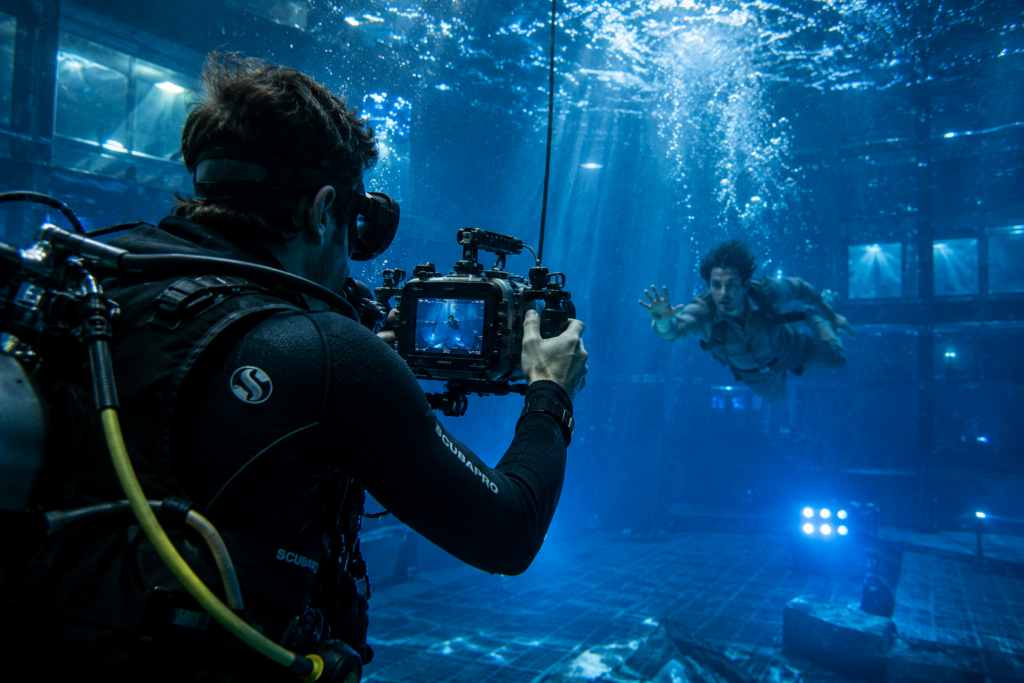
When a director chooses to film in actual water, performance preparation transforms into an intense athletic discipline. Traditional SCUBA gear is generally impractical for lead actors because full-face masks obstruct facial expressions, and escaping air bubbles clutter the camera’s line of sight.
To solve this, major productions require actors to undergo rigorous training in static and dynamic freediving (the practice of prolonged breath-holding under expert supervision).
Behind-the-Scenes Safety Standards
For James Cameron’s Avatar: The Way of Water, elite military and freediving instructors spent months training the cast. The results broke industry records: actress Kate Winslet held her breath underwater for a staggering 7 minutes and 15 seconds during production, surpassing Tom Cruise’s impressive 6-minute mark set on Mission: Impossible – Rogue Nation.
Beyond physical endurance, aquatic sets operate under strict safety ecosystems:
-
Dedicated Safety Divers: For every actor in the water, at least two professional safety divers are stationed just inches outside the camera frame, holding spare air regulators ready for immediate deployment.
-
Standardized Hand Signals: Because verbal communication is impossible underwater, actors and crew use strict, non-verbal sign language to communicate fatigue, ear pressure issues, or the need to surface immediately.
-
Facial Relaxation Techniques: Actors must learn to suppress natural physical panic reflexes, maintaining calm, relaxed facial expressions while holding their breath under intense physical stress.
Underwater Motion Capture: The Digital Revolution
Motion capture (mocap)—where actors wear suits outfitted with tracking markers to drive 3D digital characters—has long been a staple of fantasy and sci-fi filmmaking. However, performing performance capture underwater was considered virtually impossible for years.
Traditional motion capture systems rely on infrared cameras tracking body markers. In water, infrared light bounces off water molecules and surface reflections, generating thousands of “ghost points” that confuse computer tracking software.
To overcome this, the engineering team on Avatar: The Way of Water developed a groundbreaking underwater motion capture system:
-
Surface Polystyrene Spheres: The surface of the filming tank was covered with a thick layer of floating white plastic balls. This layer prevented studio ceiling lights from reflecting into the water while still allowing actors to break through the surface safely whenever they needed air.
-
Calibrated Underwater Sensors: Specially designed underwater camera arrays and waterproof, highly reflective suit markers were engineered to ignore optical water distortions.
This technological leap made it possible to capture every subtle muscle twitch, eye movement, and stroke of an actor’s performance while swimming naturally in a real aquatic environment.
Lighting, Audio, and Camera Housings: Overcoming Technical Barriers
Capturing crisp cinema footage and clean audio underwater requires custom-engineered production gear built to withstand high water pressure.
| Technical Category | Engineering & Operational Solution |
| Camera Protection (Hydro Housings) | High-end digital cinema cameras are sealed inside marine-grade aluminum and optical glass enclosures. Remote focus and exposure controls are routed to the surface via fiber-optic cables. |
| Submersible Lighting Rigs | Waterproof LED panels with wireless DMX control are anchored at the bottom of filming tanks, allowing the lighting department to adjust color temperature and intensity instantly from the surface. |
| Hydrophones & Underwater Speakers | While live underwater vocal recording is rarely usable due to muffled audio, underwater speakers allow actors to hear the director’s instructions and dialogue cues while submerged. |
| Post-Production Sound Design (ADR) | Nearly all underwater dialogue and breathing sounds are re-recorded in soundproof studio booths during post-production (Automated Dialogue Replacement) and mixed with custom acoustic sound effects. |
Conclusion
Filming underwater scenes represents the ultimate convergence of physical human endurance, classical theatrical illusion, and cutting-edge engineering. There is no single universal method: while some directors embrace the physical reality of deep-water tanks and freediving actors, others leverage digital motion capture or the dry-for-wet technique to craft imaginative fantasy worlds.
The seamless blend of relentless actor preparation, vigilant safety divers, custom camera housings, and post-production artistry is what transforms concrete soundstage tanks into vast, living oceans. The next time you watch a hero navigate the ocean depths on screen, you will appreciate the tremendous craftsmanship hidden beneath every frame.
Frequently Asked Questions (FAQ)
Are actors’ live underwater voices used in the final movie?
Rarely. Water muffles vocal acoustic clarity, making live underwater speech sound unintelligible. The vast majority of underwater dialogue, gasps, and breathing cues are re-recorded by the actors in a studio sound booth during post-production (ADR) and blended with professional sound design.
How does makeup stay on during extended underwater shoots?
Special effects makeup artists use medical-grade, waterproof cosmetic products formulated with silicone bases, acrylic fixatives, and specialized waxes. Additionally, dedicated makeup teams stand by at the tank’s edge to apply touch-ups every time an actor surfaces for a break.
What is the difference between SCUBA diving and freediving on a movie set?
SCUBA gear (air tanks and regulators) is worn by the technical crew and safety divers so they can stay submerged for hours at a time. Actors rely on freediving (breath-holding) because air tanks hide their facial expressions and output large streams of bubbles that disrupt lighting and ruin shots.
How long can actors continuously shoot inside a water tank?
Even though tank water is heated to comfortable temperatures, physical exhaustion and skin wrinkling limit continuous exposure. Actors typically take scheduled breaks every 30 to 45 minutes to rest, rehydrate, dry off, and warm up outside the water.