
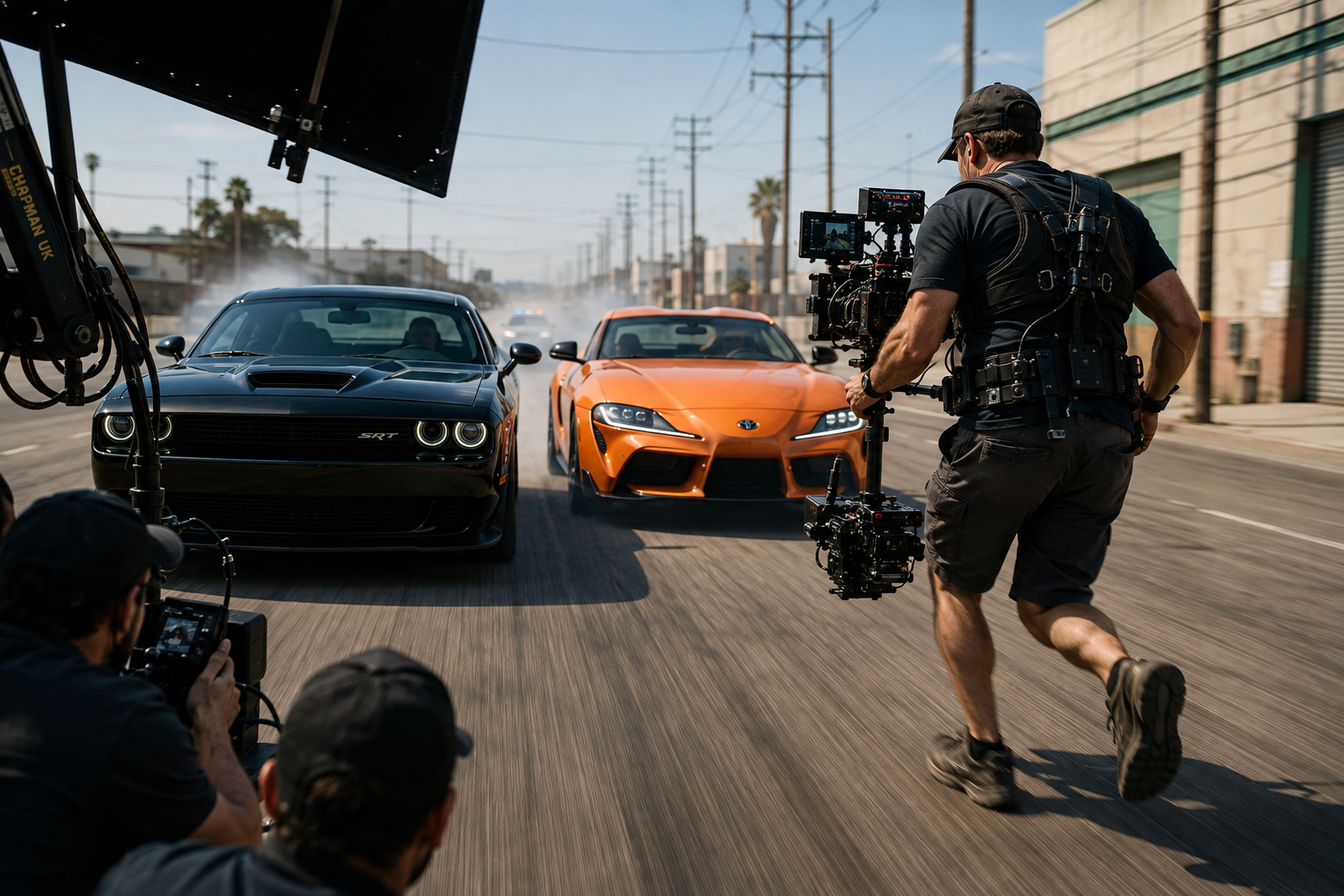
Behind the Scenes of One-Shot Movie Scenes: How They Are Made
In modern cinema and television, few techniques evoke as much wonder as the one-shot sequence (often called a long take or plan-séquence). This refers to a scene filmed continuously without visible edits, where the camera tracks the action in real time. When executed masterfully, this stylistic choice transports the audience directly into the narrative, creating an unparalleled sense of urgency, realism, and immersion.
Films like 1917, Birdman, and Children of Men, along with iconic TV moments in True Detective and The Bear, have immortalized unbroken single takes that leave viewers spellbound. But what actually happens on the other side of the lens? The illusion of seamless fluidity on screen masks a high-stakes combination of human engineering, military-grade synchronization, and complex technological solutions. This article pulls back the curtain to reveal the behind-the-scenes mechanics and clever tricks that turn impossible continuous shots into cinematic history.
What Is a One-Shot Scene and Why Does It Captivate Audiences?
A one-shot sequence occurs when an entire scene—or even an entire feature film—is captured in a single, uninterrupted take. Unlike traditional editing, where story flow is assembled by cutting between different camera angles (shots and reverse shots), a long take requires the camera to move continuously through space, constantly adapting its framing to the action.
This aesthetic choice fundamentally alters how the audience perceives time and space. Without traditional cuts to skip quiet moments or accelerate narrative pacing, viewers experience events at the exact same tempo as the characters. This unbroken continuity creates a palpable psychological tension: we instinctively feel that anything could go wrong at any second, keeping our attention locked squarely on the screen.
Exhaustive Planning: When the Movie Set Becomes a Choreographed Dance
The success of a one-shot scene is rarely determined during actual filming; it is earned through months of meticulous pre-production. While standard scene setups allow for corrections during editing, a continuous take must be flawless from the first second to the last.
The process begins with scene blocking, where the director and the director of photography (DP) map out every step the actors will take alongside every trajectory the camera will follow.
-
Precision floor marks: Actors, camera operators, and dolly grips rely on exact physical marks on the floor. If an actor stops just four inches off their mark, they risk falling out of focus or blocking another character’s light.
-
Dynamic focus pulling: The focus puller (1st assistant camera) faces one of the most grueling jobs on set. Utilizing wireless follow-focus systems and high-precision monitors, they must adjust lens focus constantly as both the camera and actors move in real time.
-
Dialogue and action timing: If a five-minute single take is ruined by a missed line in the final ten seconds, the entire take must be scrapped, forcing the entire crew back to square one.
Because of this zero-margin-for-error environment, rehearsals for a complex long take closely resemble modern ballet rehearsals, requiring dozens of crew members to move in absolute synchronization.
The Technology Behind the Moving Camera
Without breakthroughs in camera stabilization and mechanical engineering, modern continuous tracking shots would be impossible to execute at today’s level of complexity. The camera must float through space with fluid stability, eliminating the natural jolts of human footsteps.
Steadicams and Human Stabilization Rigs
Invented by Garrett Brown in the 1970s, the Steadicam revolutionized filmmaking by isolating camera motion from the operator’s body using an articulated arm and counterweight system. Today, motorized electronic gimbals and body-harness rigs allow camera operators to run, climb stairs, and navigate tight doorways while keeping the horizon perfectly level. The operator effectively transitions from a technician into an elite camera athlete.
Cranes, Drones, and Mid-Air Camera Handoffs
For large-scale tracking shots moving from interior spaces out into wide open environments, crews execute risky mechanical handoffs. It is common for a camera to start mounted on a giant camera crane (Technocrane), be unlatched manually by two running operators on the ground, and then be clipped onto a cable-cam rig or drone to soar up into the sky—all while actively recording without a single visible glitch.
Dynamic Lighting and Sound: Invisible Production Challenges
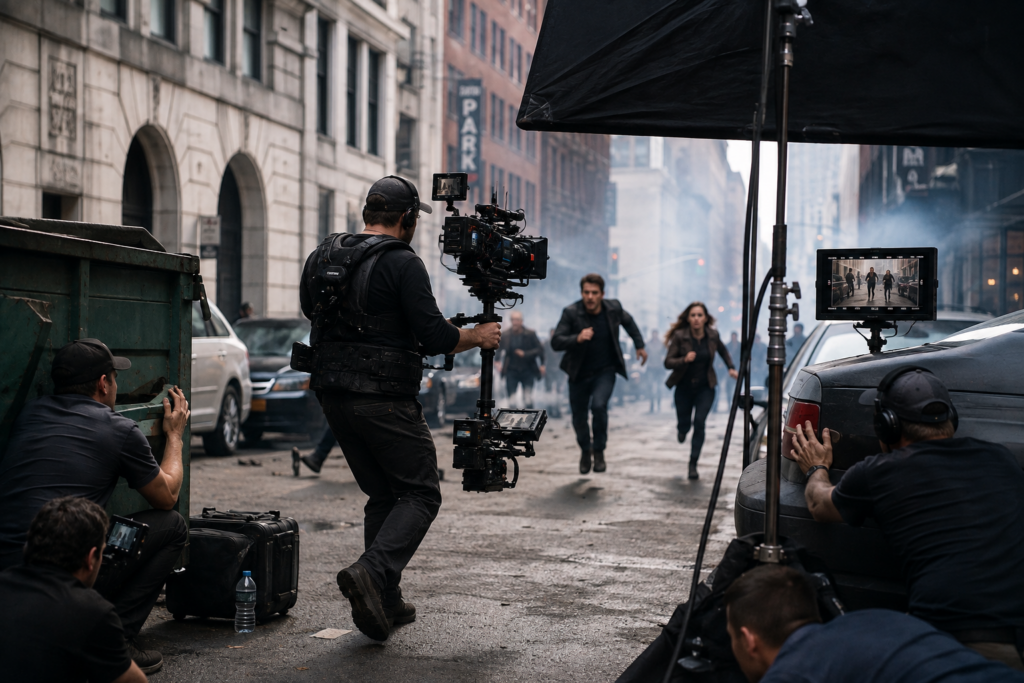
Two of the greatest technical hurdles in executing a continuous shot fall on the lighting and sound departments. In traditional filmmaking, lights, booms, and crew members stand safely just out of frame. However, when a camera spins 360 degrees around a room, there is no “behind the camera” to hide equipment.
| Technical Challenge | Behind-the-Scenes Solution |
| 360-Degree Lighting | Relying on practical lighting (ceiling fixtures, lamps, natural windows) built into the set, paired with LED panels controlled via automated DMX boards that dim up and down dynamically as the camera moves past them. |
| Visible Boom Mics | Eliminating traditional overhead boom microphones in favor of wireless lavalier mics hidden inside actors’ costumes, supplemented by boundary mics hidden within set props. |
| Exposed Crew Members | The physical crew must stay mobile. Boom operators, directors, and assistants physically run behind the camera operator in a tight huddle to remain outside the lens’s field of view. |
Real Long Takes vs. Digital Illusions: Post-Production in Action
Not every continuous shot you see on screen was captured in one single take from start to finish. With advancements in visual effects (VFX), directors frequently employ hidden cuts to stitch multiple long takes together, creating the seamless illusion of a single continuous shot.
Post-production teams utilize several classic techniques to hide these transitions:
-
Whip Pans: The operator rapidly whips the camera from one character to another, creating a natural motion blur. Editors hide the cut within the peak of that blur.
-
Wipe Transitions: The camera passes closely behind an actor’s back, a dark wall, or a large pillar, temporarily filling the frame with darkness. This brief moment allows editors to slice the tail of one take onto the head of another.
-
CGI Digital Stitching: Masterpieces like Birdman and 1917 utilized 3D environment scanning and digital background replacement to blend dozens of separate takes together. The edges of consecutive shots are aligned frame-by-frame on computers so precisely that the human eye cannot detect the seam.
Note: Using hidden cuts does not diminish the difficulty of filming. Teams still have to capture extraordinarily long individual takes while matching actor movement, lighting intensity, and wind speed down to the exact frame for smooth stitching.
Case Studies: Behind the Scenes of Classic Cinema Long Takes
To appreciate the immense physical effort required on set, consider the behind-the-scenes mechanics of three iconic cinematic sequences:
1. Children of Men (2006) – The Car Ambush
Director Alfonso Cuarón and cinematographer Emmanuel Lubezki wanted to capture a chaotic roadside attack from inside a moving car. Because the camera needed to rotate 360 degrees inside a vehicle carrying five actors, there was no physical room for a human operator. The crew built a custom car with a modified roof containing a mechanical camera rig suspended on tracks. As the camera rotated inside, the vehicle’s seats automatically tilted backward on hydraulics to clear path space for the moving rig.
2. True Detective (2014) – The Neighborhood Raid
In the fourth episode of Season 1, director Cary Fukunaga directed a six-minute uninterrupted shot following Rust Cohle through a live gunfire situation across a real housing project. The shoot required coordinating dozens of extras, stunt drivers, real pyrotechnics, and helicopter overhead support. The production team negotiated with neighborhood residents to sync physical entryways, while the Steadicam operator climbed over high fences with a heavy camera rig in real time.
3. 1917 (2019) – The World War I Trench Run
Designed to feel like two continuous long takes spanning an entire film, director Sam Mendes and cinematographer Roger Deakins had miles of real WWI trenches dug to exact measurements corresponding to the walking pace of the lead actors. If clouds suddenly moved across the sun and changed the natural lighting mid-take, filming was stopped instantly, as matching lighting across stitched takes in post-production would have been impossible.
Conclusion
The one-shot sequence remains one of the ultimate expressions of collaborative artistic ambition in filmmaking. It demands that technology, performance, direction, and physical camera operation run with the precision of a Swiss watch.
The next time you watch a long tracking shot glide across your screen without cutting, remember that behind that seamless moment of cinematic magic stands an entire crew holding their breath, running just out of frame, and pushing physical and technical boundaries to deliver an unforgettable story.
Frequently Asked Questions (FAQ)
What is the longest genuine one-shot movie in cinema history without hidden cuts?
Russian Ark (2002), directed by Aleksandr Sokurov, is one of the most famous examples of an authentic single-take feature film. The entire 96-minute movie was filmed in one continuous take inside the Hermitage Museum in Russia, using a custom digital camera mounted on a Steadicam rig.
How do actors memorize lines and cues for such long takes?
Preparing for a continuous long take is similar to rehearsing for live theater. Actors rehearse their dialogue, blocking, and timing repeatedly for weeks before cameras roll so that their performances become instinctual, allowing them to adapt naturally if minor unexpected events happen during the take.
Is filming a one-shot sequence more expensive than traditional shooting?
Generally, yes. While actual filming time for the final sequence might seem short, the financial costs associated with extensive rehearsal days, specialized camera stabilization equipment, custom-built sets, and larger crew requirements significantly increase production budgets.
What is the difference between a long take and a one-shot sequence?
A “long take” simply refers to an individual shot that lasts significantly longer than the average edit duration in a movie, but it may focus on a static subject. A “one-shot sequence” covers an entire narrative scene or story sequence—complete with changes in location, dramatic beats, and action dynamics—without a single cut.